

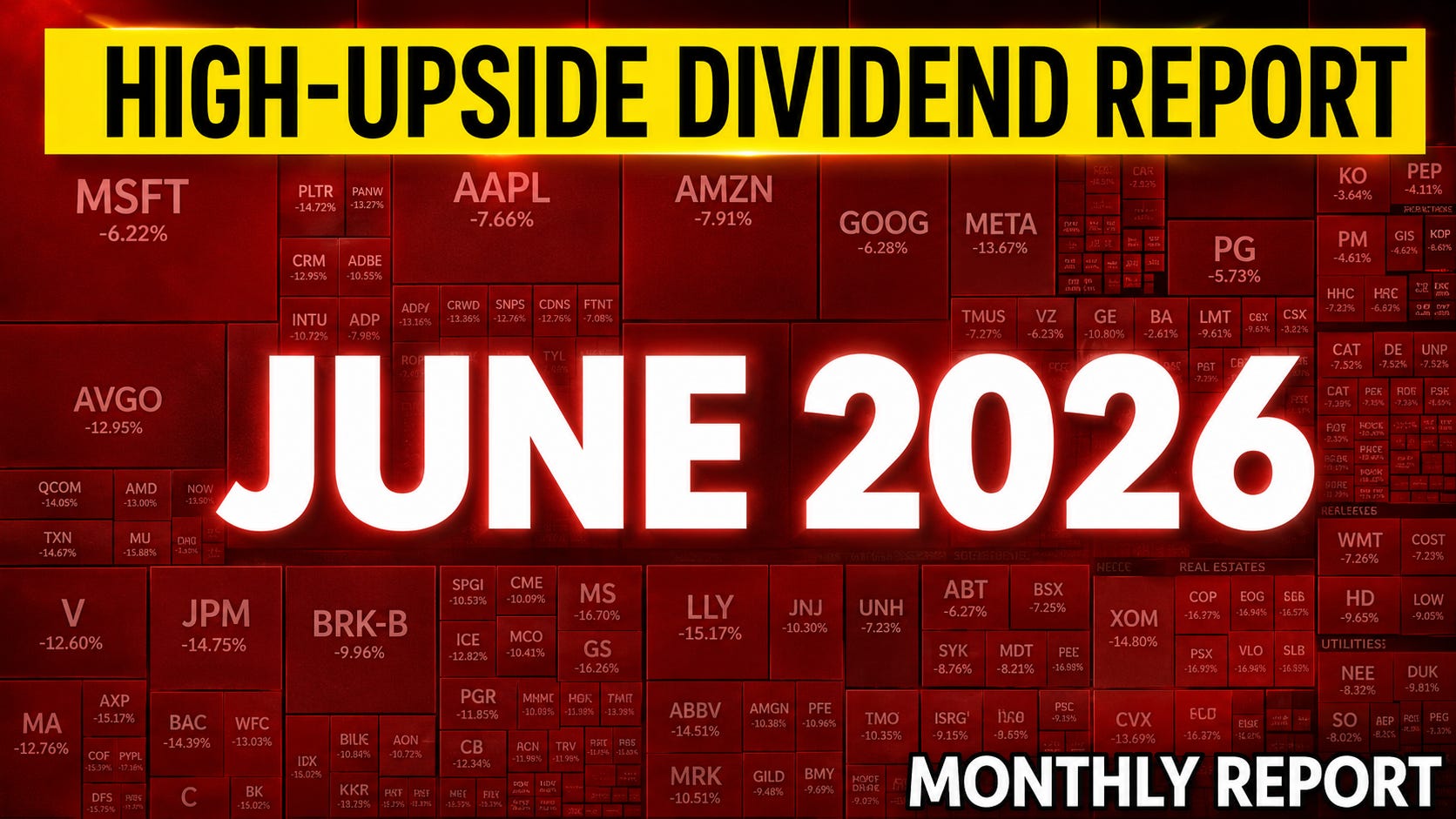
The market is getting interesting again.
Not because everything is crashing.
Not because everything is cheap.
But because the market is starting to split.
On one side, we still have the same AI winners, mega-cap tech names, semiconductor stocks, and high-growth companies that have dominated investor attention for the last 18 months.
On the other side, we are starting to see early signs of rotation, broader participation, and a market that may finally be looking beyond the same handful of names.
That creates risk.
But it also creates opportunity.
And that is exactly why this month’s paid report is focused on one simple question:
Out of hundreds of Wall Street Buy-rated stocks, which ones actually look worth researching today?
Not the most hyped stocks.
Not the most popular stocks.
Not the names with the craziest price targets.
But the stocks where analyst upside, valuation, profitability, market cap, dividend profile, Smart Score, and risk-adjusted opportunity all line up better than the rest.
For this month’s screen, I reviewed 308 Buy-rated stocks.
From there, only 30 made the premium shortlist.
And today, paid subscribers get both:
The full written June 2026 High-Upside Dividend Report
The complete sortable Excel workbook behind the screen
Before we get into the list, though, we need to talk about the market backdrop because the macro setup matters a lot here.
This report takes a lot of time to build each month, and every share helps support the work.
The goal is simple: cut through the noise, screen the market properly, and focus on the companies that may actually deserve deeper research.
The Macro Setup: Fear Is Back, But The Market Is Not Broken
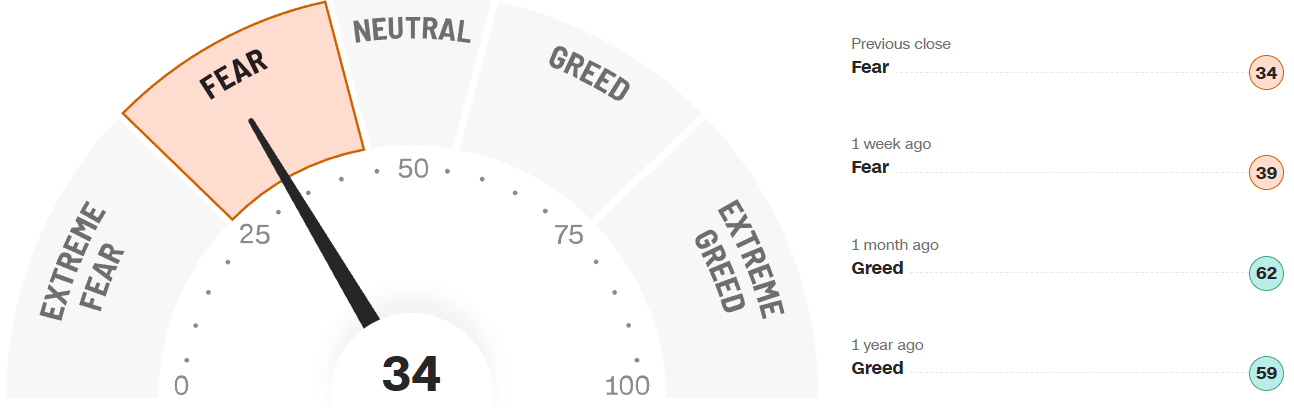
The CNN Fear & Greed Index is back in Fear territory.
That alone does not mean investors should panic.
In fact, fear can often be useful.
Markets tend to become most dangerous when investors assume nothing can go wrong. Right now, we are not there. The market has become more cautious, more selective, and more sensitive to bad news.
That is not necessarily a bearish setup.
It is a more disciplined setup.
And after the run we have seen in AI, semiconductors, mega-cap tech, and the S&P 500, that is probably healthy.
The S&P 500 is still up strongly year-to-date, but the tone underneath the surface has shifted.
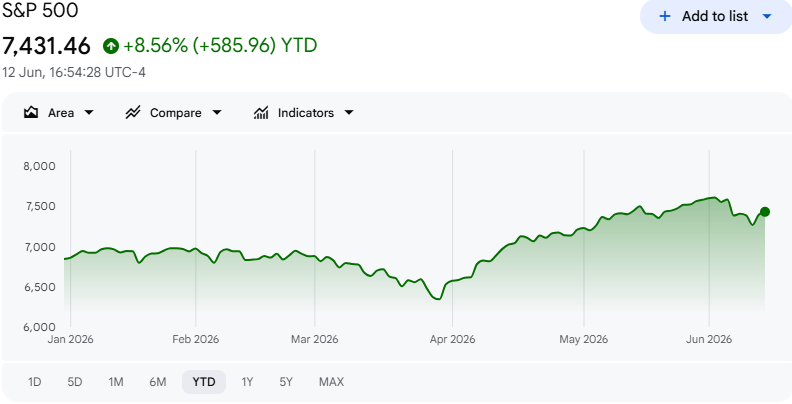
The index has had a strong year.
But the gains have not been evenly distributed.
A huge portion of the market’s strength has come from the same dominant themes: AI infrastructure, semiconductor demand, hyperscaler capex, and mega-cap technology.
That has worked extremely well.
But it also means investors need to be careful about concentration risk.
When the same trade works for too long, everyone crowds into it.
And once expectations become too high, even great companies can become vulnerable to sharp pullbacks.
Last Week: Rotation Under The Surface
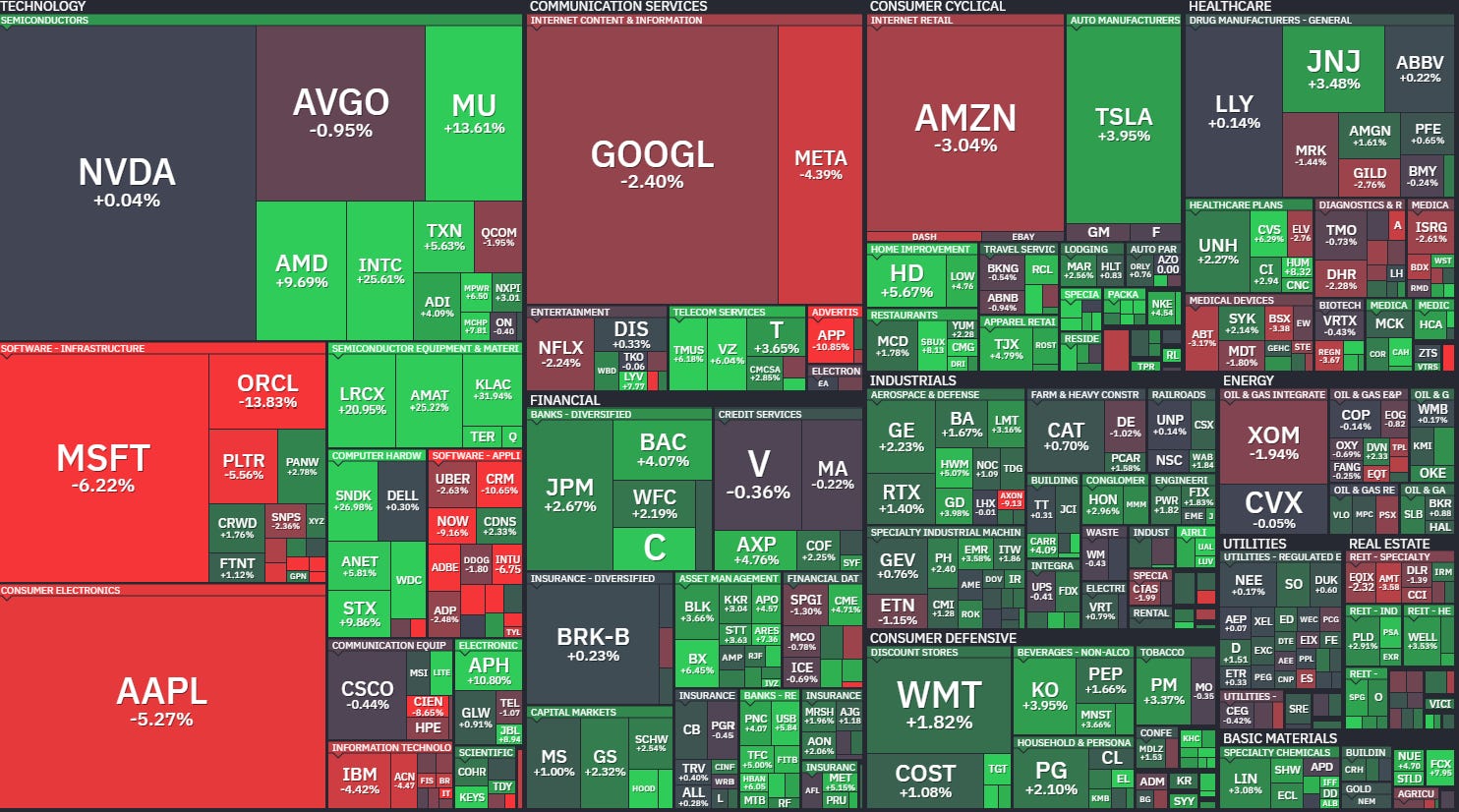
Last week’s market action was a good example of how strange this market has become.
It was not a simple “risk-on” or “risk-off” week.
Some mega-cap tech names were under pressure.
Apple, Microsoft, Amazon, Alphabet, Meta, and Oracle all had weakness in different parts of the week.
But at the same time, we saw strength in other areas of the market.
Financials were stronger.
Parts of healthcare were stronger.
Industrials were stronger.
Some consumer staples and defensive names started to catch a bid.
That matters.
Because the healthiest bull markets are not built on one sector forever.
At some point, leadership needs to broaden.
And this is the exact type of environment where a stock screen becomes more useful than simply buying whatever has already gone up the most.
Month-To-Date: The Market Is Starting To Broaden
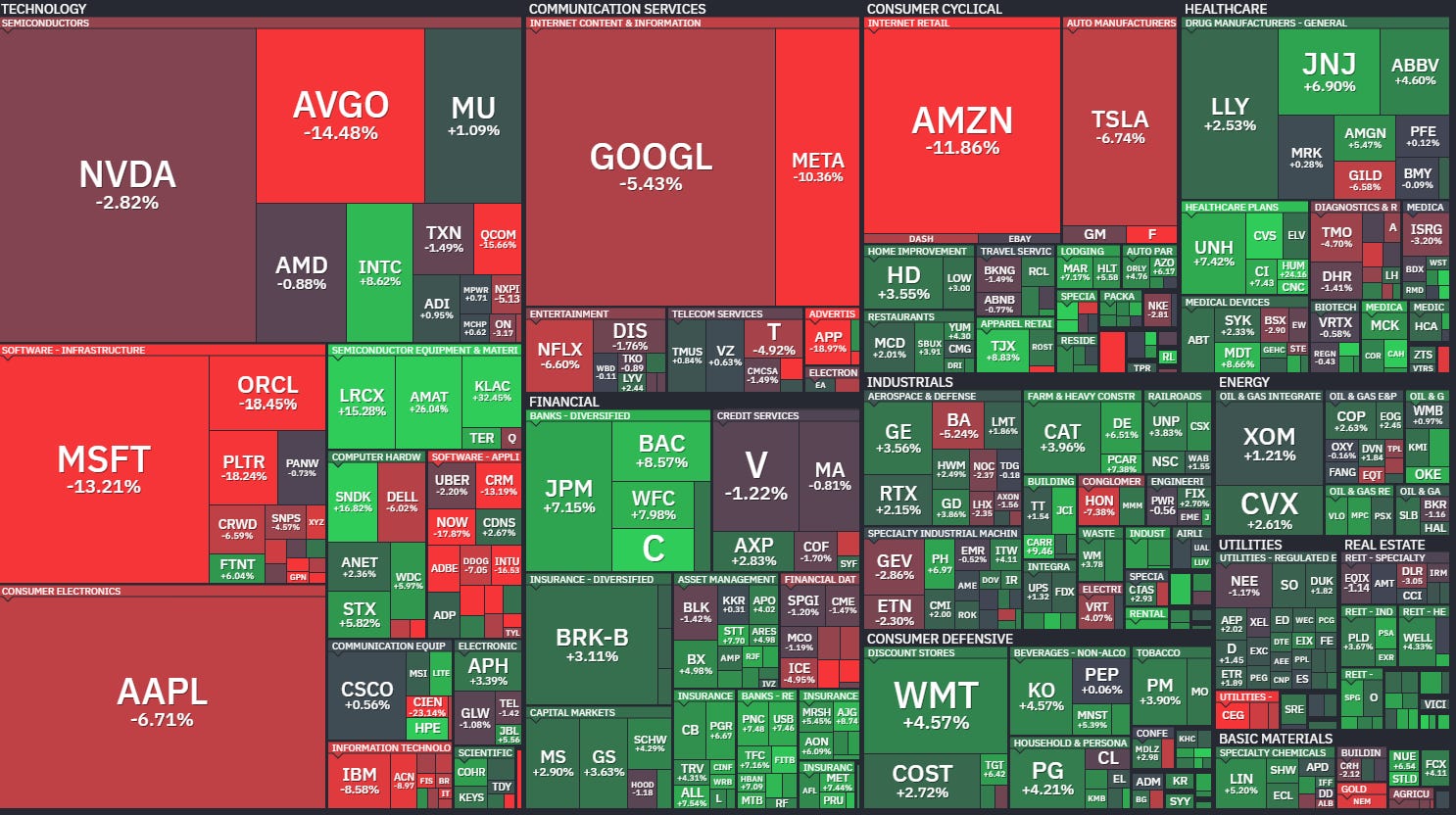
The month-to-date heatmap tells a similar story.
Tech has become more mixed.
AI winners are no longer going straight up every day.
But beneath the surface, many non-tech areas have started to work.
That does not mean the AI trade is over.
It means the market may be moving from a narrow momentum phase into a more selective phase.
And that is where valuation starts to matter again.
When everything is going up, investors ignore price.
When the market becomes more selective, price starts to matter a lot more.
That is why I wanted this month’s screen to focus on more than just analyst upside.
A stock showing 70% upside is not automatically attractive.
Sometimes it is cheap for a reason.
Sometimes the analyst target is stale.
Sometimes the business has poor profitability.
Sometimes the market is already warning you that something is wrong.
So the goal of this report is not to blindly chase upside.
The goal is to find the highest-quality upside.
The AI Trade Is Cooling, Not Breaking
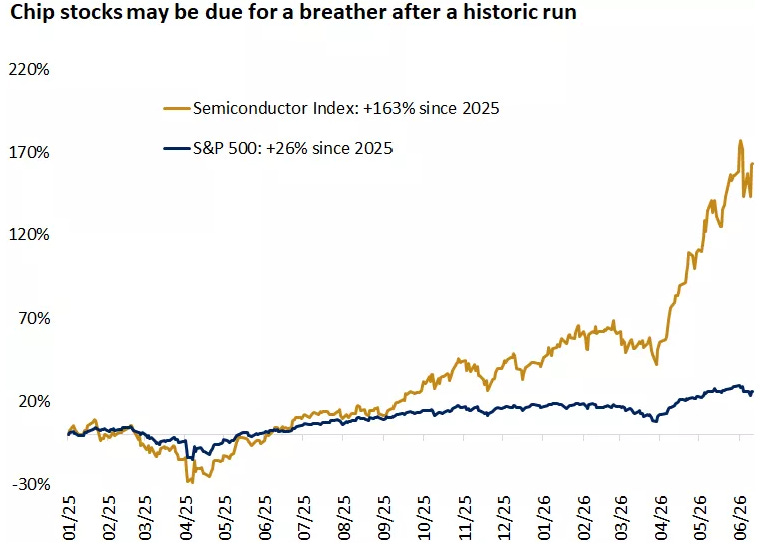
Semiconductor stocks have had a historic run.
Since 2025, the semiconductor index has massively outperformed the S&P 500.
That makes sense.
AI demand has exploded.
Data center spending has surged.
Nvidia has become one of the most important companies in the world.
Broadcom, AMD, Micron, TSMC, ASML, Applied Materials, Lam Research, and other semiconductor-related names have all benefited from the AI infrastructure cycle.
But even the best themes can move too far, too fast.
And when a trade becomes crowded, investors do not need bad fundamentals to sell.
Sometimes they just need a reason to take profits.
That appears to be what is happening now.
The AI story is still alive.
The long-term demand is still real.
But the market is beginning to ask a more important question:
How much of the future has already been priced in?
That is the key difference between a great business and a great investment.
A great business can still become a poor investment if expectations get too high.
AI Spending Is Still Massive
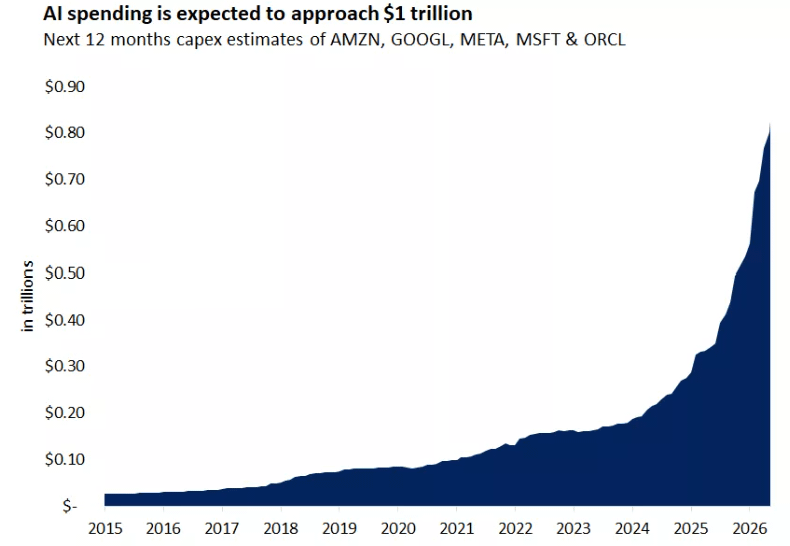
At the same time, it would be a mistake to pretend the AI investment cycle is suddenly over.
The expected capex from Amazon, Alphabet, Meta, Microsoft, and Oracle remains enormous.
AI infrastructure spending is expected to approach $1 trillion over the next 12 months.
That is a staggering number.
And it explains why investors continue to give premium valuations to the companies supplying the AI buildout.
But this is also where the debate gets more complicated.
On one hand, massive capex supports semiconductor demand, cloud infrastructure, power demand, data centers, software tools, and the broader AI ecosystem.
On the other hand, investors are starting to ask whether this spending will generate enough returns to justify the scale of investment.
That is why I do not think this market is simply “bullish” or “bearish”.
It is more nuanced than that.
The AI buildout is real.
But valuations are no longer universally attractive.
Some names still look compelling.
Others look priced for perfection.
And that is why selectivity matters.
The Average Stock May Have Catch-Up Potential
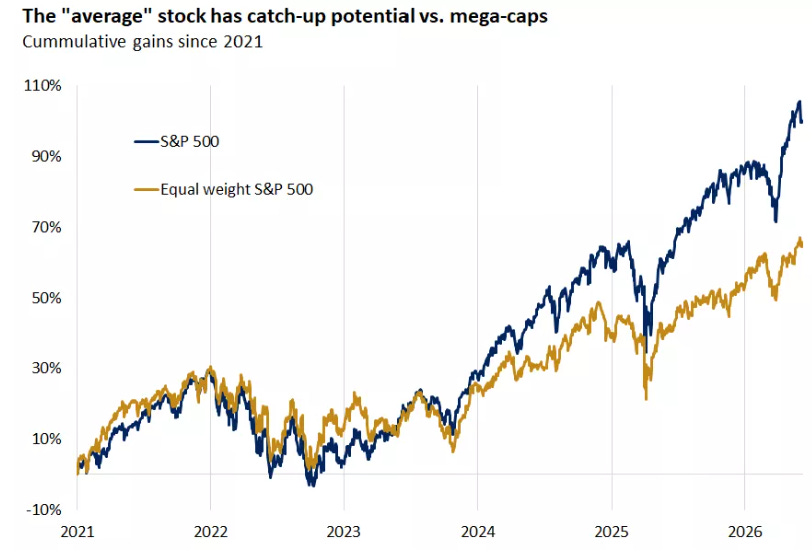
One of the most important charts right now is the gap between the market-cap weighted S&P 500 and the equal-weight S&P 500.
Since 2021, mega-cap stocks have dramatically outperformed the average stock.
That has created a very top-heavy market.
But it also means there may be catch-up potential outside the mega-cap leaders.
This is one of the reasons I like running screens like this.
The best opportunities are not always hiding in the most obvious places.
Sometimes they are in companies that have been ignored because they are not part of the current market obsession.
Sometimes they are in quality businesses trading at compressed valuations.
Sometimes they are in dividend-paying companies where investors are being paid to wait.
And sometimes they are in beaten-down sectors where expectations have become too low.
That does not mean every laggard is attractive.
Many laggards deserve to lag.
But when Wall Street is still positive, valuation has compressed, and the risk-adjusted setup improves, those names become worth reviewing.
SpaceX, IPO Fever, And Market Liquidity
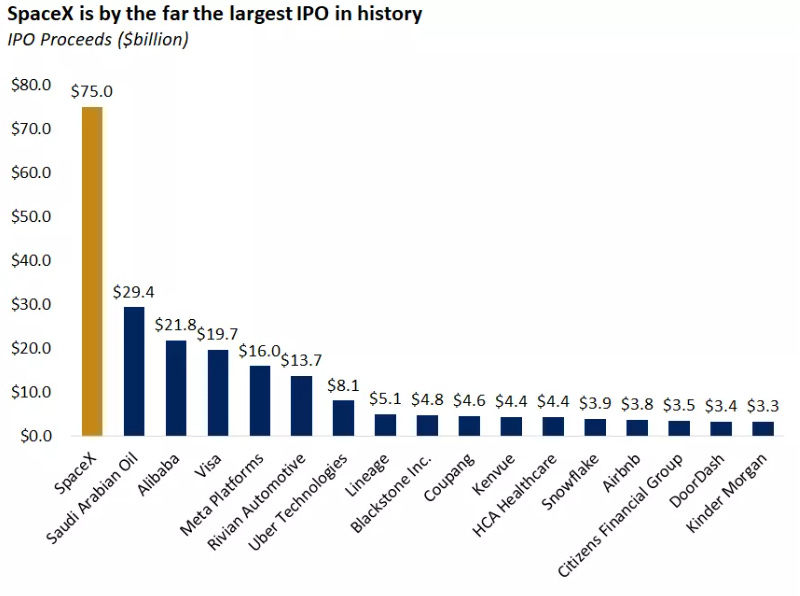
The other major market event is the SpaceX IPO.
This is not just another IPO.
It is the largest IPO in history.
And that matters because IPOs are not just company events.
They are liquidity events.
When a huge new stock enters the market, investors need to fund it somehow.
Some capital comes from new inflows.
But some capital often comes from selling existing holdings.
That can create pressure elsewhere in the market, especially if the IPO is large enough to become a major talking point across institutional and retail investor circles.
The bigger issue is what SpaceX represents.
It is not just a space company.
It is a symbol of the current market environment:
Huge private-market valuations
Massive investor demand for growth
AI and infrastructure excitement
Founder-led premium
Scarcity value
FOMO
That can be powerful.
But it can also be dangerous.
History suggests that the largest IPOs often struggle after the initial excitement fades.
Big IPOs Usually Require Discipline
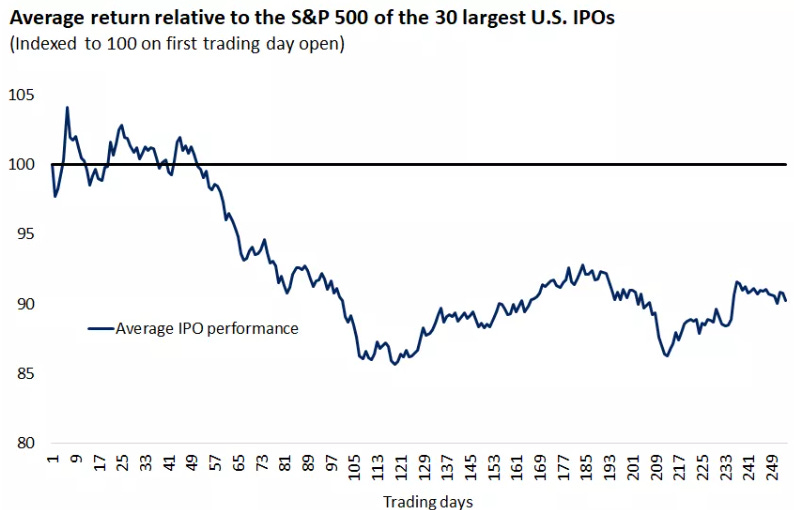
The average performance of the 30 largest U.S. IPOs relative to the S&P 500 is a useful reminder.
The excitement is usually highest at the start.
The returns are not always best at the start.
That does not mean SpaceX will fail as a stock.
It means investors should separate the company from the valuation.
A company can be extraordinary and still be a poor investment at the wrong price.
That idea applies far beyond IPOs.
It also applies to the stocks in today’s screen.
Just because Wall Street is bullish does not mean a stock is automatically attractive.
The screen is a starting point.
Not a final answer.
Inflation, Oil, And The Fed
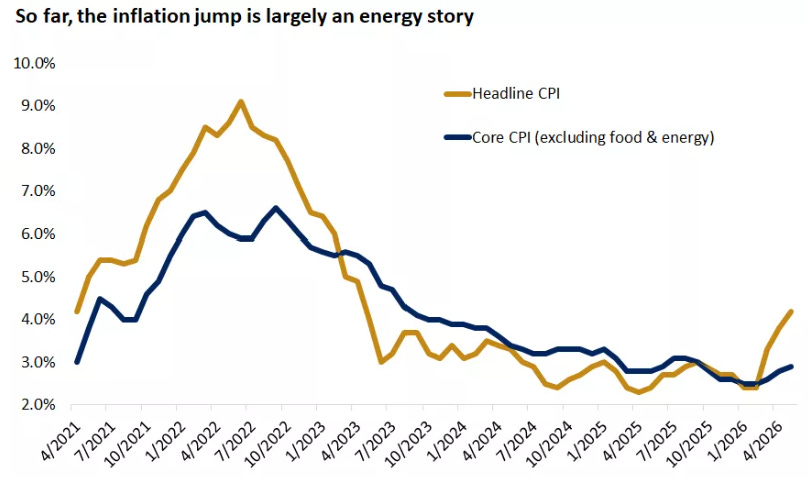
The inflation picture is also important.
Headline inflation has moved higher, but much of the recent pressure appears to be energy-related.
Core inflation has been more contained.
That matters for the Fed.
If inflation is being driven mainly by oil and energy, the Fed may be less likely to respond aggressively than it would if core inflation were accelerating across the economy.
This is where geopolitics becomes important.
If tensions ease and energy prices fall, the inflation scare may calm down.
If energy prices spike again, the market may start worrying about higher-for-longer rates or even the possibility of renewed tightening.
That is why the Strait of Hormuz headlines matter.

Whether investors like the political noise or not, the market does care about energy flows.
Oil prices feed into inflation expectations.
Inflation expectations feed into bond yields.
Bond yields feed into equity valuations.
And equity valuations determine how much investors are willing to pay for future earnings.
That is why macro still matters.
Even if this month’s report is focused on individual stocks, the backdrop affects the multiple investors are willing to pay.
The Key Takeaway
The market is not broken.
But it is changing.
The leadership is broadening.
The AI trade is cooling after a huge run.
IPO activity is testing investor risk appetite.
Inflation remains tied to energy.
And investors are becoming more selective.
That is exactly the kind of market where stock picking becomes more important.
Not because every stock is cheap.
But because dispersion is increasing.
Some stocks are still expensive.
Some stocks are finally interesting.
And some stocks may offer attractive upside if the fundamentals, valuation, and analyst conviction line up.
That brings us to this month’s paid report.
Sponsored: Seeking Alpha Sale
🚨 Seeking Alpha’s latest sale is now LIVE 🚨
For a limited time, you can get 25% OFF:
✅ Seeking Alpha Premium: $299 → $225/year + 7-day free trial
✅ Alpha Picks: $499 → $375/year
✅ Premium + Alpha Picks Bundle: $718 → $545
The bundle looks like the strongest value here because you get both the full Seeking Alpha Premium research platform and Alpha Picks in one package with the biggest total discount at $173 off.
If you’ve been waiting to try Seeking Alpha Premium or Alpha Picks, this is probably the best time to do it.
👉 Claim the 25% OFF offer here:
https://www.sahg6dtr.com/29N4DP9/R74QP/
Become a Paid Subscriber
The rest of this article is for paid subscribers.
Inside the paid section, you’ll get:
The full June 2026 High-Upside Dividend Report
The complete sortable Excel workbook
The 308-stock Buy-rated universe
The Top 30 premium-ranked shortlist
The Top 5 highest-ranked names
A dividend-aware subset
A large-cap quality watchlist
Risk buckets and manual-review flags
My interpretation of which names look most worth researching first
If you want the full report and Excel workbook every month, upgrade below.