

The Index Is Holding Up. Individual Stocks Are Crashing.
The S&P 500 is still positive this year.
You would not know it from looking at many individual stocks.
Across the market, high-quality businesses have quietly fallen toward or through their 52-week lows. Some have declined because earnings expectations weakened. Others have been caught in sector rotations, valuation compression or company-specific uncertainty.
And a falling share price creates a dangerous illusion:
A stock can look considerably cheaper without becoming genuinely undervalued.
That distinction matters today.
Over recent weeks, market leadership has shifted dramatically. Financials and healthcare have advanced, while technology, communication services and consumer discretionary stocks have lagged.
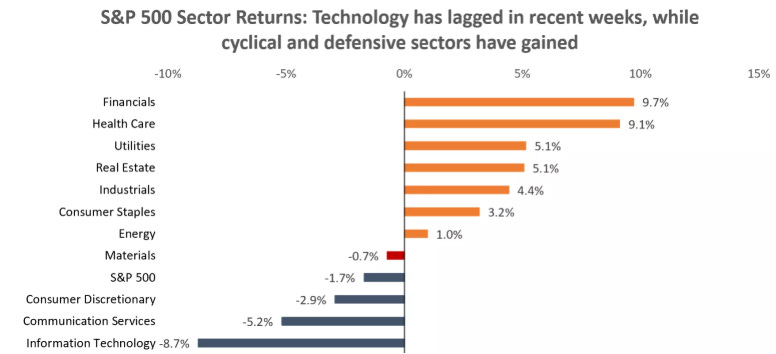
This is not an indiscriminate market collapse.
It is a market increasingly separating companies, sectors and investment narratives from one another.
The S&P 500 recently fell by approximately 1.6% over five trading days, yet beneath the surface several widely followed companies suffered significantly larger declines. Fear has returned, individual-stock volatility is rising and investors are becoming less willing to pay premium valuations without clear evidence of durable earnings growth.
Yet there is an important contradiction.
While share prices have weakened across parts of the market, aggregate earnings expectations have not collapsed. S&P 500 second-quarter earnings-growth forecasts have actually been revised materially higher, with technology and energy responsible for much of the improvement.
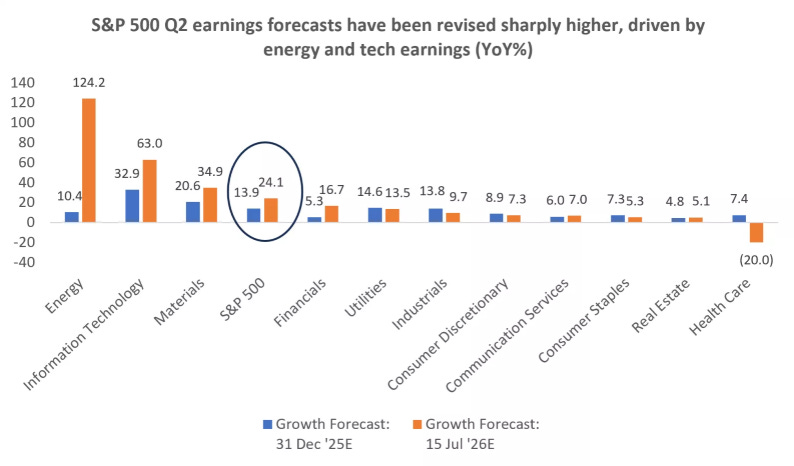
That means today’s market is not offering one simple conclusion.
Some stocks are falling because their previous valuations were unsustainable.
Some are falling because the underlying businesses are deteriorating.
And some may be falling despite their long-term fundamentals remaining intact.
Those three situations can look almost identical on a share-price chart - but they produce completely different investment outcomes.
This Is Becoming a Stockpicker’s Market
The dispersion between the index and its individual constituents has increased sharply.
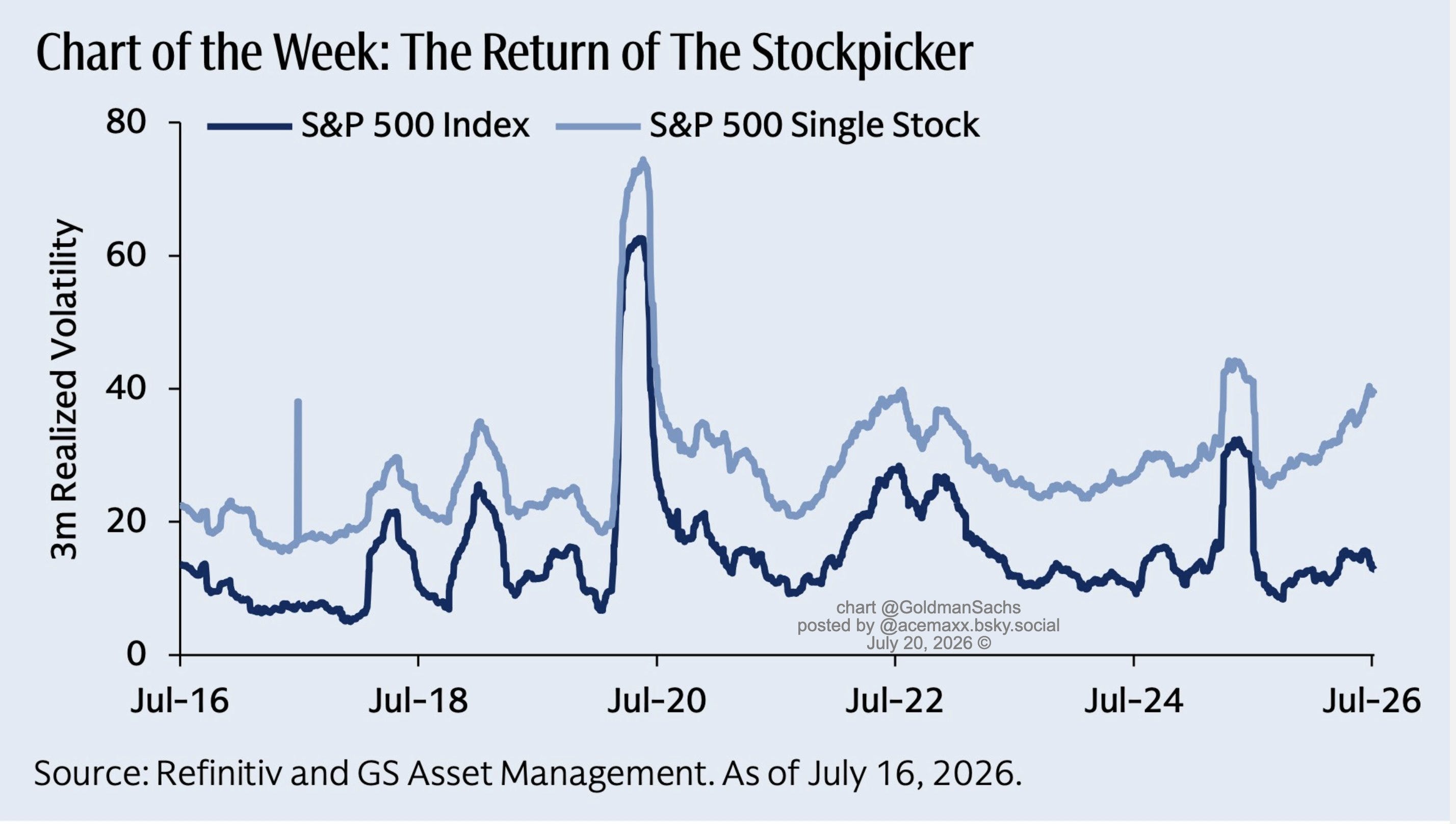
That is precisely the environment in which valuation discipline matters most.
I am not interested in buying a stock simply because it is down 20%, 30% or even 50%.
A lower share price is only attractive when the decline creates a sufficient gap between price and conservative intrinsic value - without requiring heroic assumptions or ignoring structural damage to the business.
I selected eight established companies trading near their 52-week lows or significantly below their recent highs:
Each has a recognisable and established business.
Each has suffered a meaningful valuation reset.
Each has a plausible recovery or long-term compounding case.
But each must clear the same non-negotiable hurdle.
A Minimum 20% Margin of Safety
To qualify, a company must trade at least 20% below my conservatively estimated intrinsic value.
But the DCF result is only the starting point.
I also examined:
What growth the current share price already implies
Forward valuation relative to historical levels
Bear, base and bull-case outcomes
Balance-sheet and free-cash-flow strength
Whether recent weakness is temporary or structural
The principal risk that could invalidate the valuation
The objective is not to identify the stock with the largest theoretical upside.
It is to find the businesses where quality, price and expectations finally align.
Of the eight companies tested, only three currently offer a margin of safety above 20%.
Several famous businesses came surprisingly close.
Others remain significantly overvalued despite trading near their lows.
And one of the three that passed offers the widest gap between price and my estimate of intrinsic value in this screen.
Let’s begin with the first company.
7. Microsoft: Cheaper — But Not Cheap Enough
Microsoft is precisely the type of stock that makes a 52-week-low screen dangerous.
The share price has fallen approximately 19% this year. Its forward P/E has compressed dramatically, sentiment has weakened and the stock is trading much closer to the bottom of its 52-week range.
At first glance, this appears to be the opportunity investors have been waiting for.
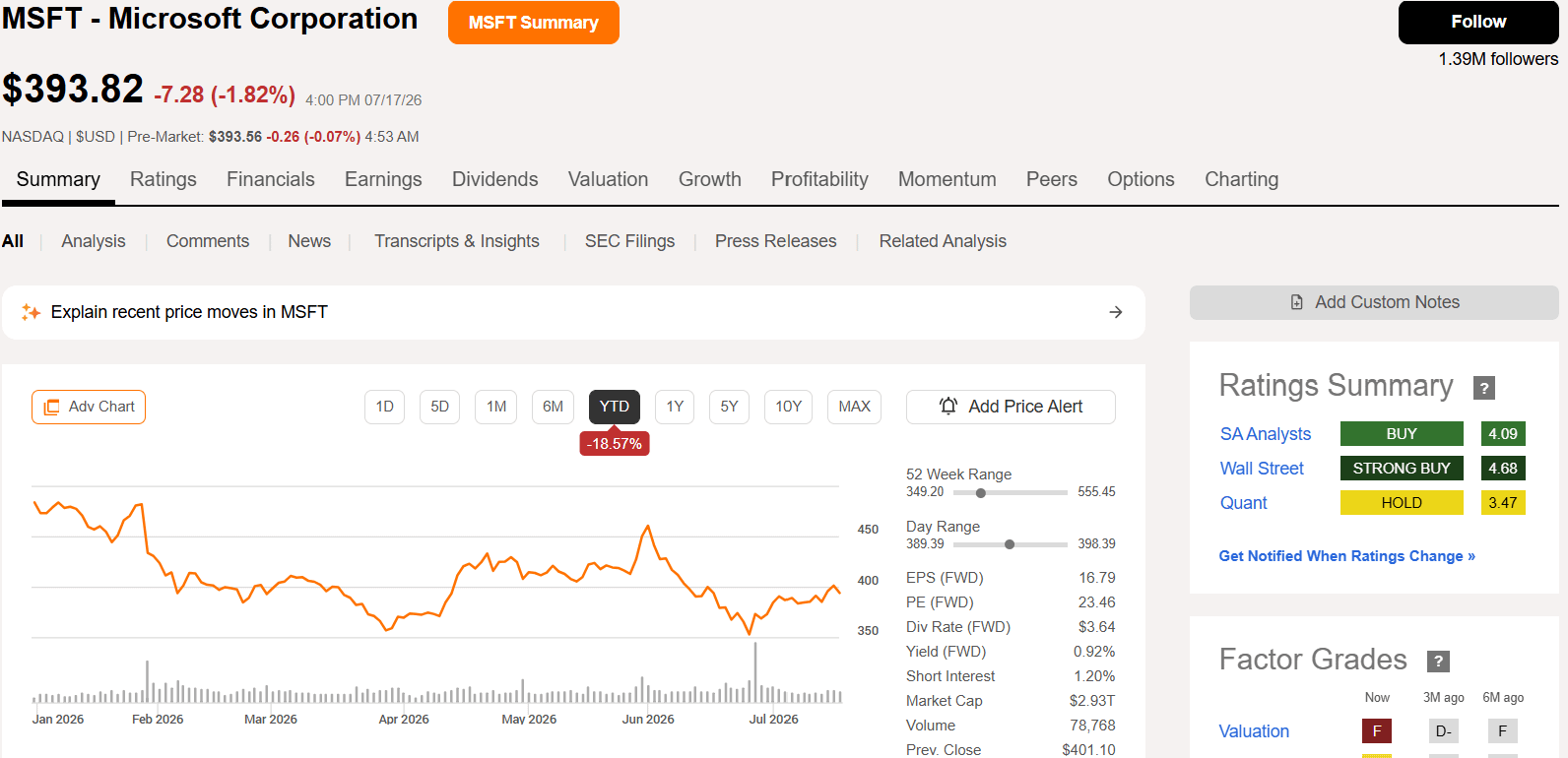
The decline has not been caused by a collapse in Microsoft’s underlying business.
In its latest quarter, revenue increased 18%, Microsoft Cloud revenue grew 29% to $54.5 billion and commercial remaining performance obligations reached $627 billion. Azure continues to benefit from strong demand, although the cost of building the infrastructure required to meet that demand is rising rapidly.
The central debate is therefore not whether Microsoft remains a high-quality business.
It clearly does.
The question is whether a great business has finally reached a great price.
A Significant Valuation Reset
Microsoft currently trades at approximately 21.3 times forward earnings, compared with a five-year average of 30.6 times.
Its dividend yield has also risen to approximately 0.92%, above its five-year average of 0.81%.
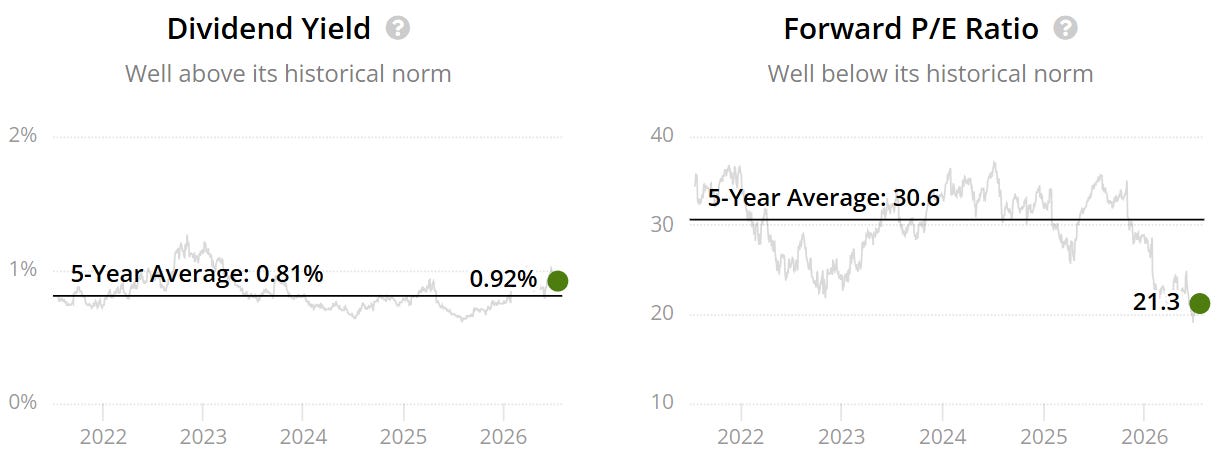
That is a meaningful reset.
However, historical valuation comparisons only tell us that Microsoft is cheaper than it used to be. They do not tell us whether the current share price offers sufficient protection if growth slows, AI infrastructure spending remains elevated or investors become less willing to pay a premium multiple.
That requires an intrinsic-value calculation.
My Updated Microsoft DCF
For the central scenario, I have assumed:
Starting free cash flow of approximately $90 billion
Long-term free-cash-flow growth of 13%
An 8% discount rate
A 3% perpetual growth rate
Those assumptions produce the following valuation range:
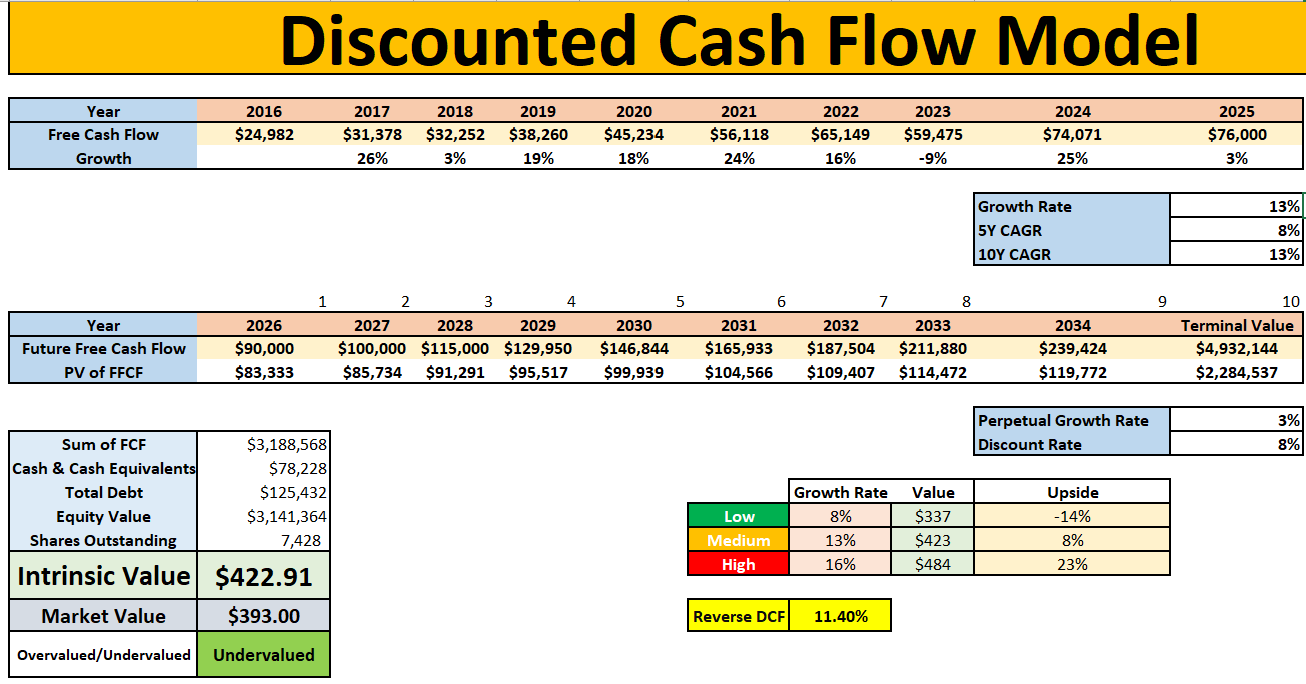
The base-case intrinsic value is approximately $422.91.
Against a share price of approximately $393, that provides a margin of safety of only:
7.1%
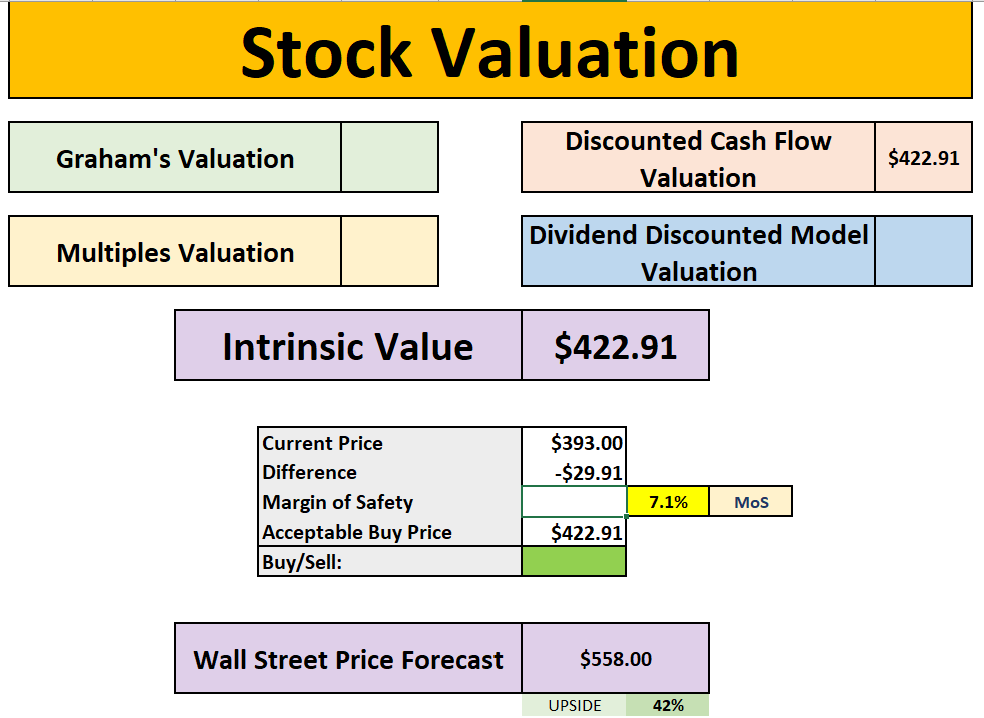
That suggests modest valuation upside, but it falls well short of the 20% hurdle required for this report.
The reverse DCF reaches a similar conclusion. At the current price, Microsoft must grow free cash flow by approximately 11.4% annually to justify the valuation.
That is achievable for Microsoft. But it is not a pessimistic expectation.
The market may be less optimistic than it was previously, but it is not pricing Microsoft like a struggling business.
My Microsoft Verdict
Microsoft is cheaper.
Its multiple is far below its recent norm, the business remains exceptionally strong and the long-term AI opportunity is substantial.
But cheaper is not the same as cheap enough.
At approximately $393, my base-case valuation offers only a 7% margin of safety. To provide the full 20% margin required by this screen, Microsoft would need to trade closer to:
$338
That does not mean Microsoft cannot deliver attractive long-term returns from today’s price.
It means investors are still being asked to pay for a significant amount of future success, while carrying the risk that AI spending remains capital-intensive, margins compress or growth merely meets rather than exceeds expectations.
Verdict: Watchlist — not a qualifying buy
Microsoft fails the test.
And it is far from the only famous company that does.
One business trading almost 30% below its 52-week high remains slightly overvalued under my base case. Two companies came within only a few percentage points of passing. And just three of the eight produced the full 20% margin of safety.
The highest-ranked stock offers:
A 6.7% dividend yield
A valuation materially below its five-year norm
Nearly 29% margin of safety
Three separate valuation methods that all point to undervaluation
Paid members unlock the complete report
This includes:
The full eight-stock ranking
All intrinsic values and qualifying buy prices
The three stocks that passed
Two near-buys within touching distance of qualifying
Bear, base and bull-case outcomes
The risks that could invalidate each valuation
My final order of preference
Paid members will also receive the next Undervalued Dividend Dashboard on 1 August, alongside immediate access to every previous premium valuation report.