

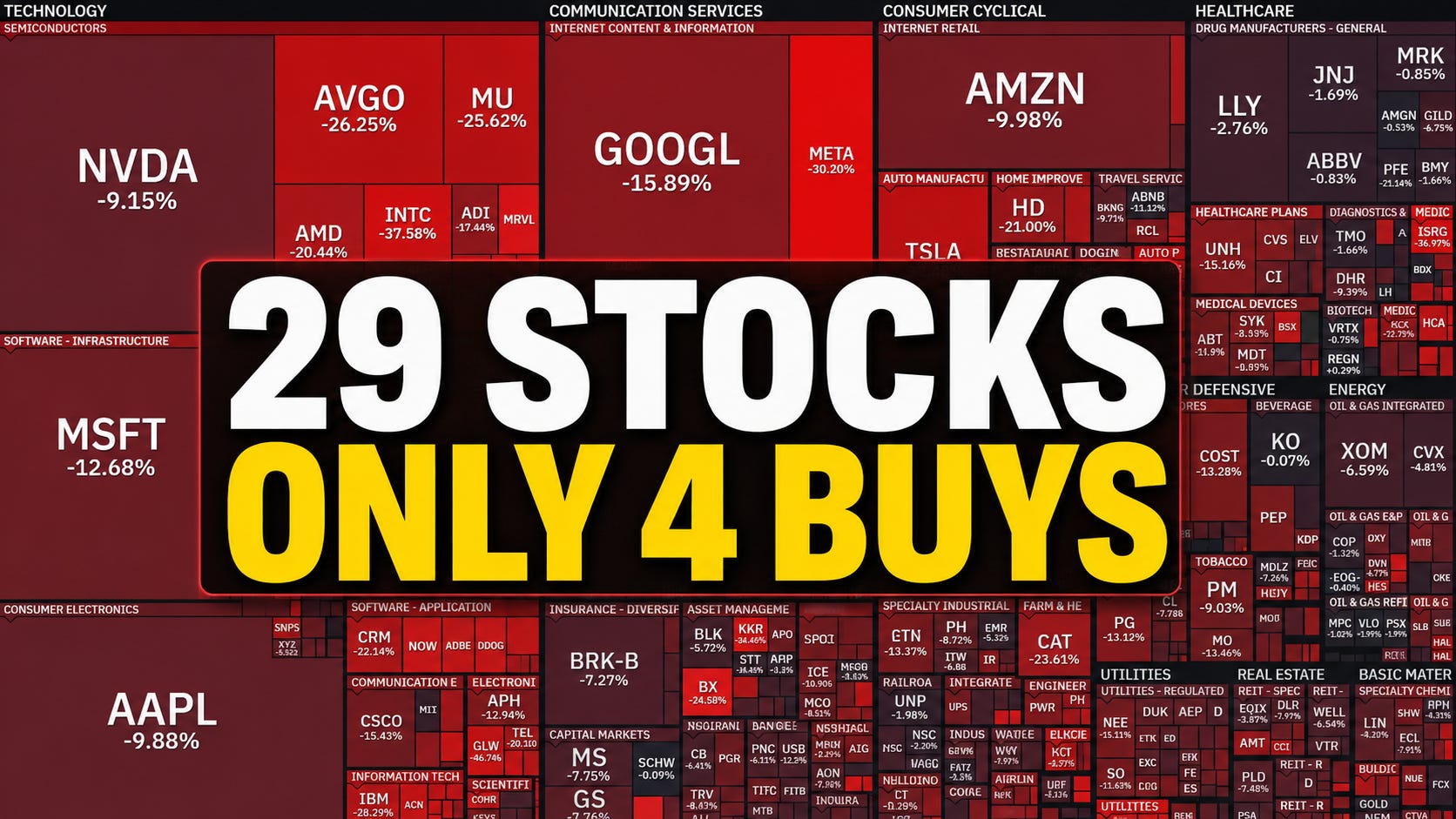
Something unusual is happening underneath the stock market right now.
Expectations for future Federal Reserve rates have been falling.
But long-term Treasury yields have been moving in the opposite direction.
At the same time, corporate earnings expectations are being revised sharply higher, the broader market is outperforming the Magnificent Seven and dozens of high-quality companies have experienced significant declines.
It has created one of the more interesting setups we’ve seen this year.
The market isn’t cheap. But parts of it suddenly are.
And that distinction matters.
Before getting into the 29 stocks trading near their 52-week lows, there are a few things happening underneath the market that I think every investor should understand.
If you enjoy valuation-focused market analysis like this, subscribe to Dividend Talks. Free members receive my weekly research, while Premium members get access to my valuation tools, stock rankings and deeper analysis.
The bond market is sending a warning
Take a look at what has happened recently.
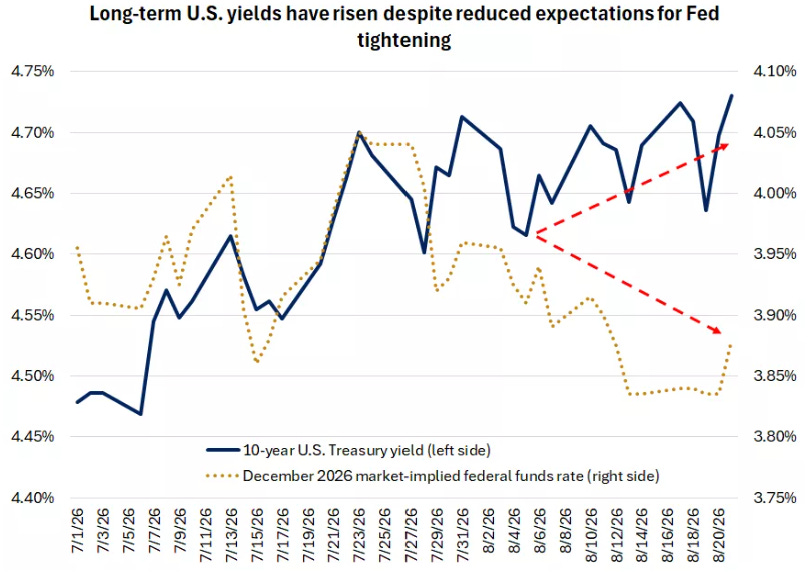
10-year Treasury yield vs. the market-implied December 2026 federal funds rate.
Normally, falling expectations for Federal Reserve rates should put downward pressure on longer-term Treasury yields.
Recently, the opposite has happened.
The market-implied Fed rate for December has moved lower, while the 10-year Treasury yield has pushed higher.
That tells us something important.
The rise in long-term rates is increasingly about more than simply what the Federal Reserve does next.
Investors are also demanding greater compensation for holding long-dated government debt.
There are several possible reasons:
Large fiscal deficits
Increased Treasury issuance
Heavy corporate borrowing
Continued uncertainty around inflation
Greater uncertainty around the future path of interest rates
And we can see this starting to show up in the Treasury term premium.
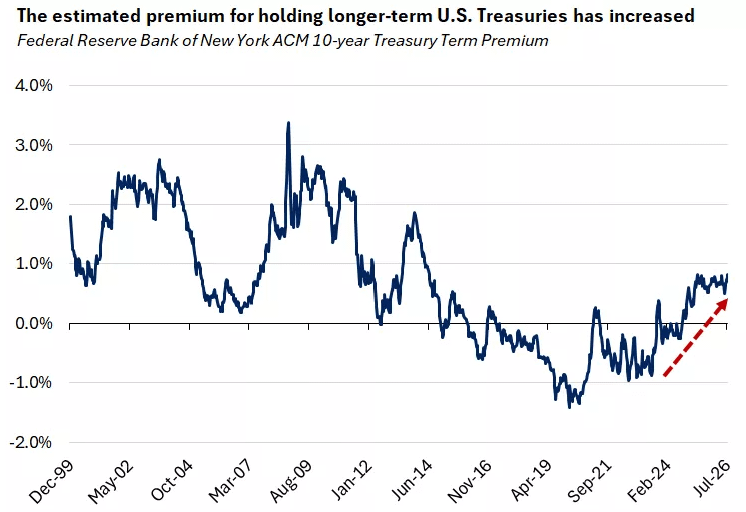
The term premium is essentially the additional return investors demand for accepting the uncertainty involved in holding long-term bonds.
After spending much of the post-financial-crisis period around zero or even negative territory, it has moved meaningfully higher again.
That doesn’t automatically signal a crisis.
But it does mean the hurdle rate for every other investment has increased.
If an investor can earn an attractive return from a relatively low-risk Treasury, a stock needs to offer a sufficiently attractive potential return to compensate for the additional risk.
That is one of the reasons valuation becomes increasingly important as yields rise.
And the move at the very long end of the Treasury market has become difficult to ignore.
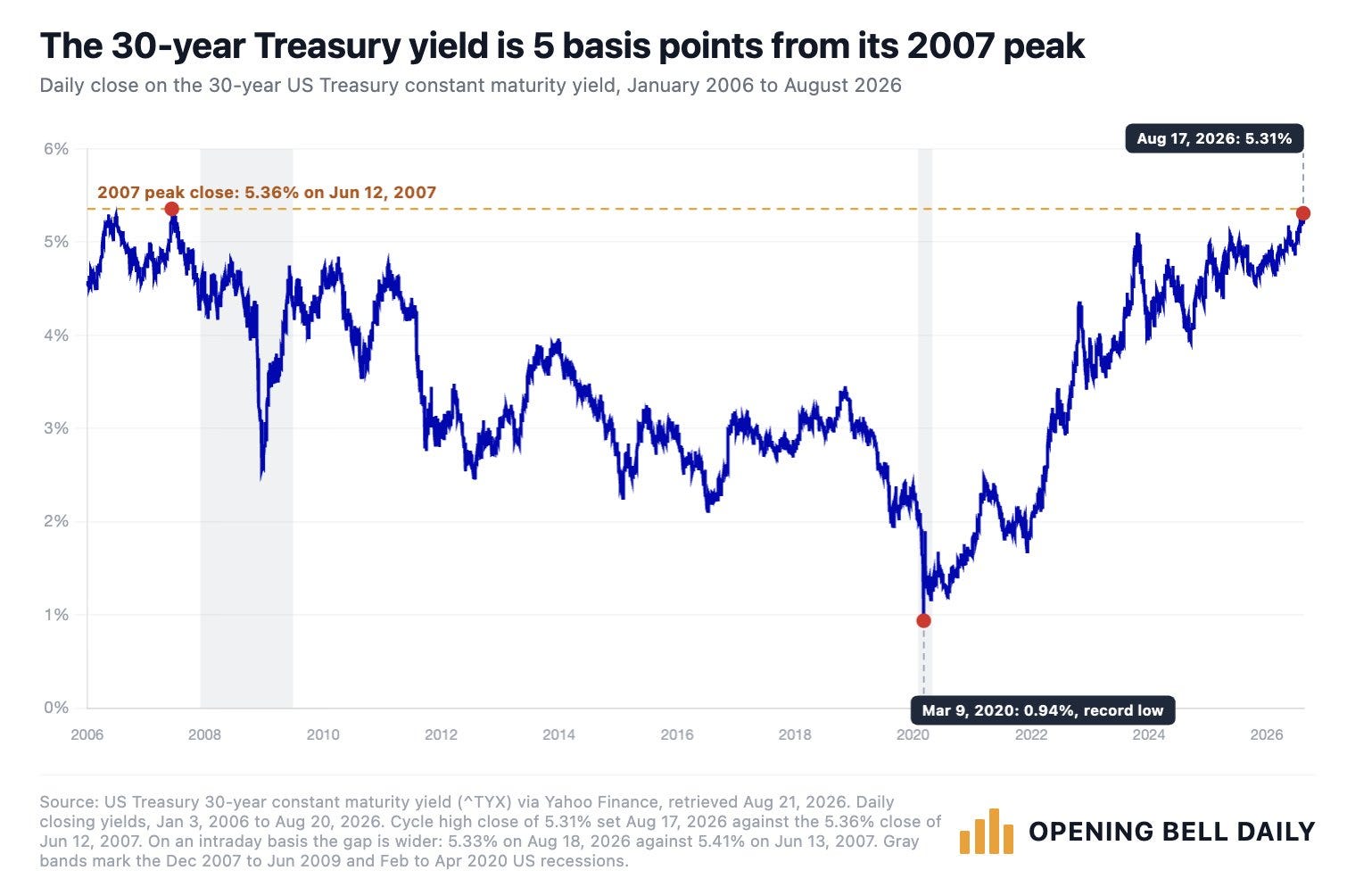
The 30-year Treasury yield recently reached approximately 5.3%, putting it close to levels last seen in 2007.
To be clear, this does not mean another 2008 is coming.
But investors have spent much of the past 15 years operating in an environment where extremely low interest rates helped support higher asset valuations.
That environment has changed.
Higher rates are beginning to bite
Housing provides one of the clearest examples.
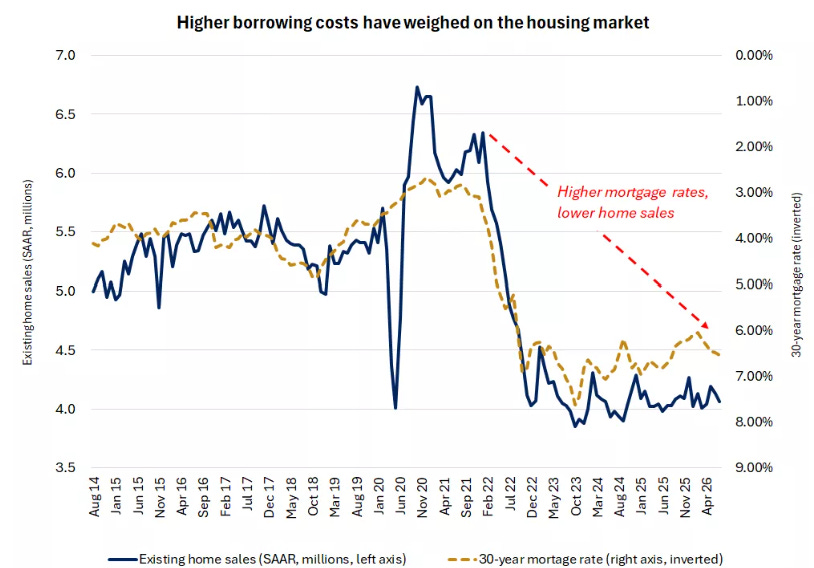
Mortgage rates have remained elevated, while existing-home sales have fallen considerably from the levels seen several years ago.
This is exactly what tighter financial conditions are supposed to do.
Higher borrowing costs make mortgages less affordable, discourage transactions and reduce activity in some of the most interest-rate-sensitive areas of the economy.
So there are genuine signs of pressure underneath the surface.
But this is where the picture becomes much more interesting.
Because despite those pressures...
Corporate America is doing remarkably well.
Earnings are getting much stronger
This may be the most important chart in today’s article.
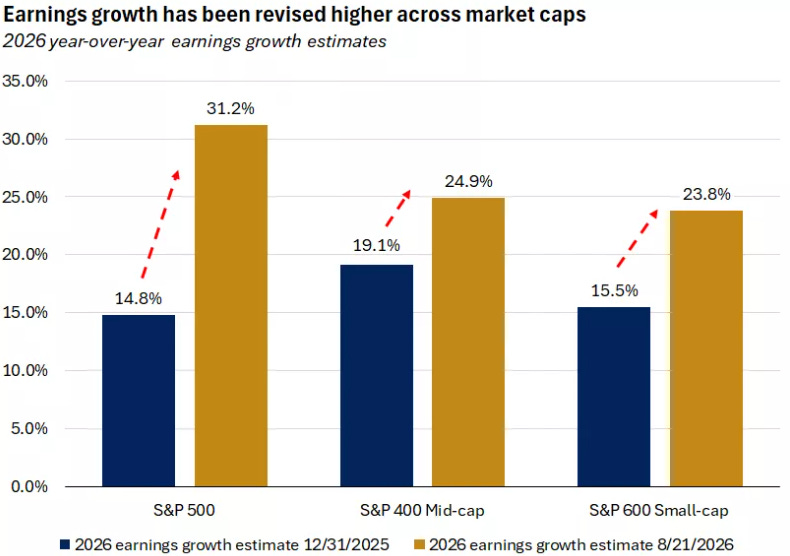
At the beginning of the year, analysts expected 2026 earnings growth of approximately:
14.8% for the S&P 500
19.1% for mid-cap stocks
15.5% for small-cap stocks
Those estimates have now risen to roughly:
31.2% for the S&P 500
24.9% for mid-caps
23.8% for small-caps
That is a significant change.
And it helps explain why the stock market has remained resilient even as long-term borrowing costs have climbed.
Stocks aren’t simply ignoring higher rates. Earnings have been rising quickly enough to offset some of the valuation pressure.
There is another encouraging development too.
This earnings strength is no longer solely about a handful of mega-cap technology companies.
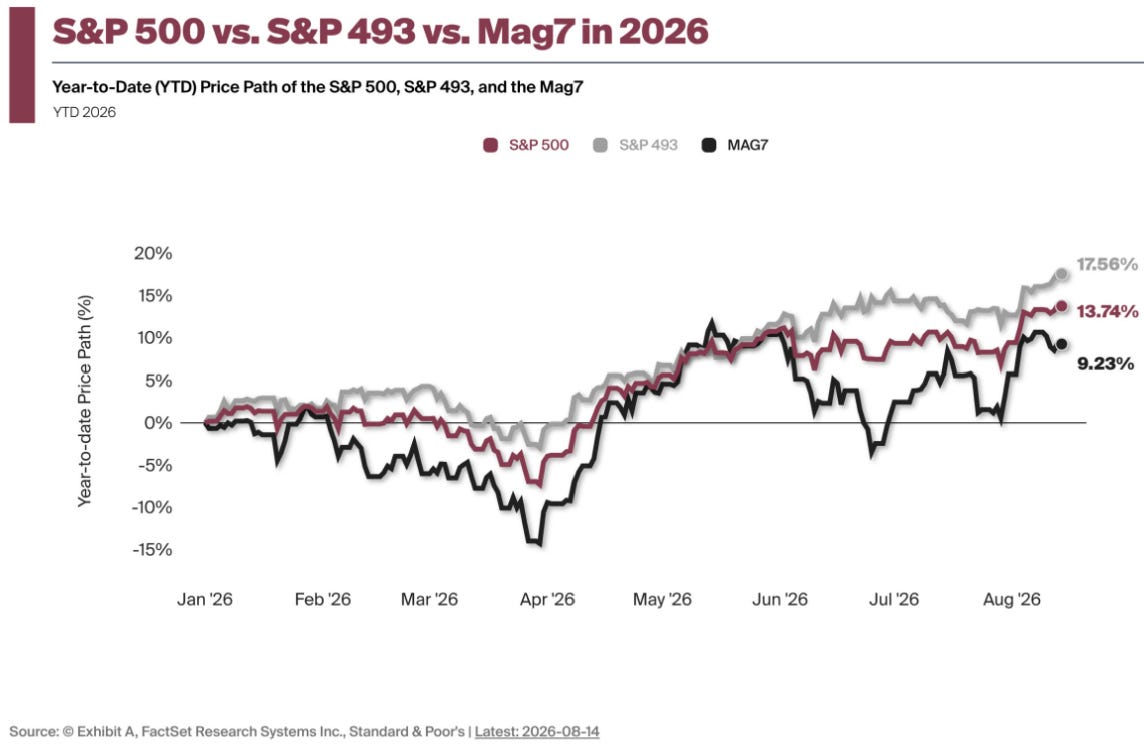
So far in 2026:
S&P 493: +17.56%
S&P 500: +13.74%
Magnificent Seven: +9.23%
The companies outside the Magnificent Seven have actually outperformed the mega-cap technology leaders.
That is a significant change from the market investors became accustomed to over the past few years.
Market breadth has improved.
And for stock pickers, I think that is important.
There are increasingly opportunities being created outside the small group of companies that dominated investor attention during the first stage of the AI boom.
Know an investor who is still only watching the Magnificent Seven? Share this article with them.
There is just one problem: stocks still aren’t cheap
Strong earnings can justify higher stock prices.
But price still matters.
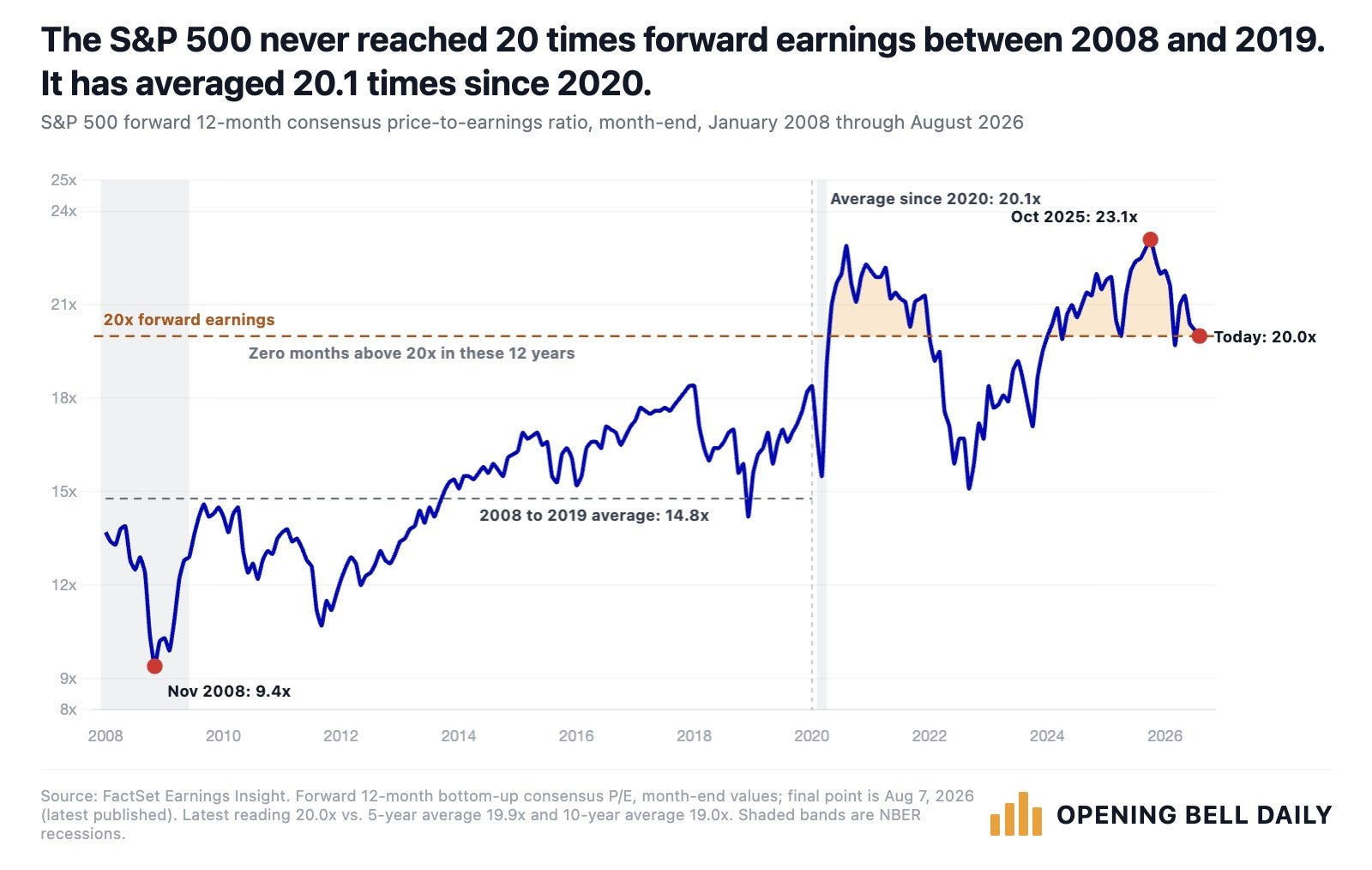
The S&P 500 currently trades at approximately 20 times forward earnings.
For some context, the index didn’t reach 20x forward earnings at any point between 2008 and 2019.
Since 2020, however, the average has moved dramatically higher.
There are good arguments for why today’s market deserves a higher valuation than it did historically.
Corporate margins are higher. Some of the largest businesses in the index are incredibly profitable. Technology represents a larger percentage of the market. Earnings growth remains strong.
But none of that makes valuation irrelevant.
In fact, with long-term Treasury yields above 4% and the 30-year yield around 5%, the price investors pay becomes even more important.
That leads us to what I think is the most interesting part of today’s market.
The index may not look particularly cheap.
But underneath the index, individual stocks have been crushed.
Over the past few months we’ve seen significant declines across technology, consumer stocks, healthcare, financials and industrials.
Some companies are down because their fundamentals have deteriorated.
Some remain expensive despite falling 20%, 30% or even more.
But others are beginning to trade at prices I haven’t seen for quite some time.
So rather than trying to decide whether the entire S&P 500 is cheap or expensive, I took a different approach.
I screened 29 stocks trading near their 52-week lows.
And then I asked a much more useful question:
Which of them are actually worth buying?
29 Stocks Near Their 52-Week Lows
Here is the complete list I started with:
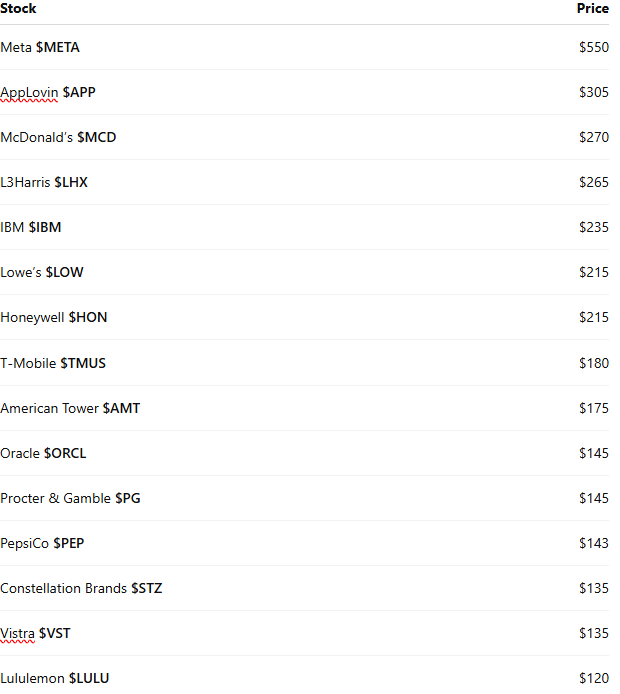
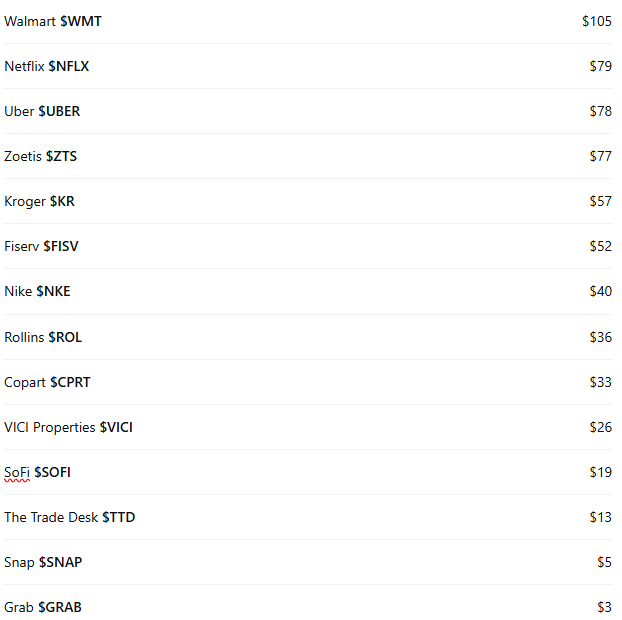
There are some huge names on this list. If you know another investor looking for opportunities after the recent sell-off, share this with them.
A 52-week low does not mean a stock is cheap
This is the most important point before we go any further.
It is incredibly easy to look at a stock that has fallen 30%, 40% or even 50% and assume that it must now represent better value.
Sometimes it does.
But sometimes the stock price has fallen because the value of the underlying business has fallen with it.
A company can be trading at its lowest price in a year and still be expensive.
Another can fall just 15% and suddenly offer one of the most attractive risk/reward opportunities in the market.
That is why I don’t think simply buying the biggest losers is a particularly useful strategy.
For each company on this list, I’m much more interested in five things:
1. Business quality
Is this a company I would actually want to own for the next five or ten years?
A low valuation doesn’t help much if revenues are permanently declining, competitive advantages are disappearing or management is destroying shareholder value.
2. Earnings and free-cash-flow potential
What matters isn’t where earnings were last year.
It is what the business can realistically earn several years from now.
That is particularly important for companies where the market is currently pricing in a major slowdown.
3. Valuation
How much optimism is still embedded in today’s share price?
A stock being down 40% means very little if it was 80% overvalued before the decline.
4. Margin of safety
Even a fantastic company can be a poor investment at the wrong price.
I want enough potential upside between today’s price and what I believe the business is worth to compensate me for the possibility that my assumptions are wrong.
5. Why the stock has fallen
Finally, I want to understand what the market is worried about.
Is the problem temporary?
Or has something fundamentally changed?
That distinction is often where the best opportunities are found.
And the differences are enormous
Once you look beyond the share-price declines, these 29 companies are not remotely equal opportunities.
Some remain priced at valuations I would struggle to justify even after their recent falls.
Some look inexpensive, but I don’t think the quality or growth outlook is attractive enough.
Others are excellent companies that are getting closer to interesting prices, but still aren’t quite cheap enough for me yet.
And then there is a much smaller group where I think the combination of:
business quality + valuation + long-term growth + potential upside
has become considerably more attractive.
I narrowed the entire list down to four stocks that stand out most to me today.
And importantly, they are not all the same type of investment.
One is among the highest-quality businesses in the entire market.
One is benefiting from a powerful long-term structural trend.
One has transformed its free-cash-flow profile.
And one offers substantially more upside if its current growth trajectory can continue.
There are also several very familiar names on the original list that didn’t make the cut.
That may actually be the more important part of the exercise.
Because the objective isn’t to find stocks that have fallen.
It’s to find situations where price has fallen further than long-term value.
The 4 stocks that stand out
For Premium members, I’ve gone deeper on the four companies that I believe offer the most interesting setups from the 29 above.
For each one, I’ll cover:
Why the stock has fallen
What the market may be getting wrong
The long-term investment case
My valuation
The biggest risk to the thesis
The price at which I would be comfortable buying
My final verdict
I’ll also explain why several other beaten-down names didn’t make my four, despite looking optically cheap after their declines.
Dividend Talks Premium gives you access to my full valuation work, buy-below prices, stock rankings and deeper research designed to answer the question that matters most: not simply whether a company is good, but whether it is worth buying at today’s price.