


October ended with an unusual split in the market. Several of the companies most closely associated with artificial intelligence sold off sharply, while large parts of health care, energy, consumer staples and the wider market held up. That can feel like the start of a broad market breakdown when the largest technology names dominate the headlines and many portfolios. The evidence points to something more selective.
The US economy is still expanding at a strong pace. Corporate earnings are growing. More stocks are participating than the cap-weighted index alone suggests. At the same time, inflation remains above the Federal Reserve’s target, Treasury yields have risen, and investors are demanding clearer proof that record AI investment will become durable cash flow.
That combination changes what I am willing to pay. I still want exposure to exceptional companies, but I do not want to treat every dip in an AI-related share as a bargain.
For this November review, I screened 242 listed shares, built a ranked quality and valuation workbook, and then applied two independent valuation tests to six companies. Five appear undervalued in my discounted cash-flow model. Only three also clear the earnings-based entry test in the companion workbook.
The full paid section identifies those three companies, gives my current action on all six, and includes the complete 242-company research workbook. Before the paywall, here is the market framework behind the list.
October exposed the difference between AI demand and AI economics
The technology sell-off is easy to see in the October heatmap. Several mega-cap AI, semiconductor and infrastructure shares finished October under heavy pressure. Meanwhile, energy, health care, consumer staples and pockets of financials remained firmer.
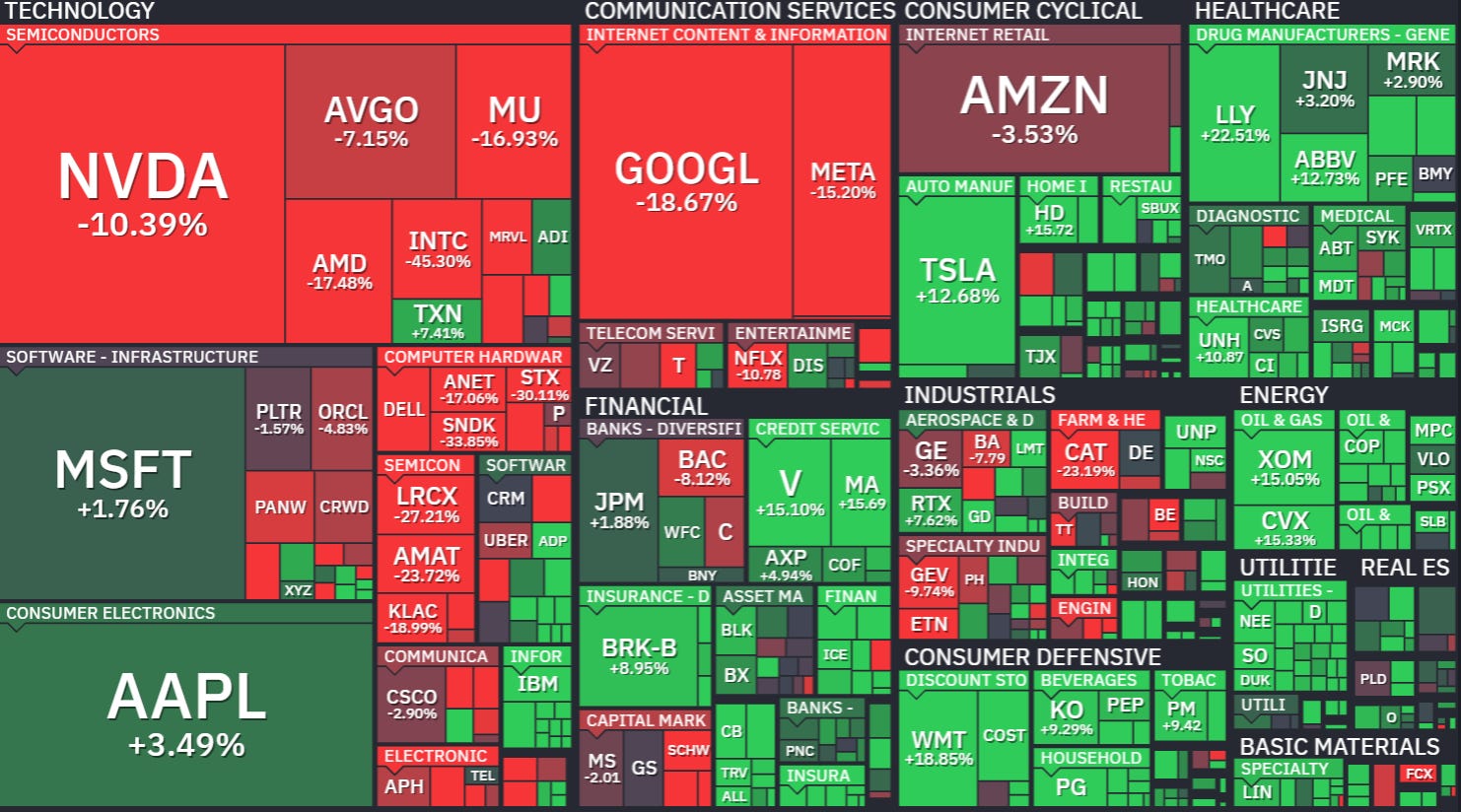
The central question is no longer whether companies want more computing capacity. Demand remains substantial. The question is whether the companies funding that capacity will earn an adequate return after depreciation, financing costs, energy use and the next round of investment.
Investors are becoming less patient with the spending plans of the largest technology companies and more selective about the cash economics behind them. The concern is not simply AI adoption. It is the amount of capital required and the evidence that the spending will lift future profits.
A company can report rapid revenue growth and still disappoint shareholders if capital intensity rises faster than cash generation. A supplier can also produce excellent near-term numbers and then suffer if a few large customers slow their orders. October was a reminder that the whole AI chain is connected.
The economy does not look like the main problem
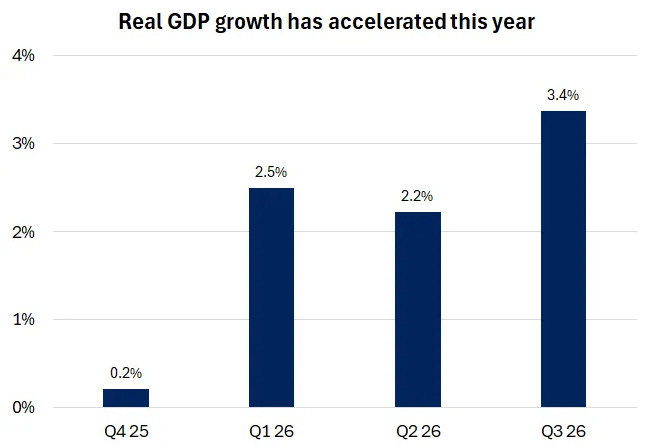
Real US gross domestic product is growing at a 3.4% annual rate in the third quarter, up from 2.2% in the second quarter. Investment, consumer spending and government spending all contributed. That is not the economic profile I would normally associate with an imminent collapse in company earnings.
Inflation is the complication. September’s PCE price index was 3.6% higher than a year earlier, while core PCE was up 3.1%. On 28 October, the Federal Reserve kept the federal-funds target range at 3.75% to 4.00%. Two voters preferred a quarter-point increase.
That mix leaves investors with a strong economy and sticky inflation. It supports revenue and earnings, but it also reduces the chance of an immediate return to very low interest rates. The valuation of long-duration growth companies therefore has to work at today’s cost of capital, not at the cost of capital investors enjoyed several years ago.
Higher yields have already removed some valuation excess
The chart below shows the relationship clearly. As the 10-year Treasury yield moved higher, the S&P 500's forward price-to-earnings ratio declined. The index is no longer trading near the most expensive point of the last several years, although it is not obviously cheap in absolute terms.
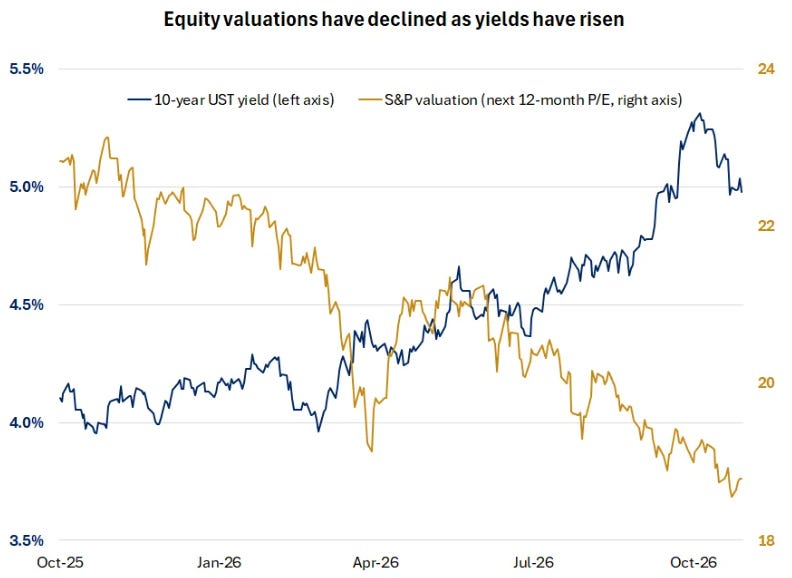
A lower multiple does not automatically make the market safe. If earnings estimates fall, the apparent discount can disappear. The more constructive interpretation is that the market has begun to demand a better balance between growth and price.
This is why I am placing more weight on cash conversion, balance-sheet strength and realistic growth assumptions. A company with rising earnings can absorb some multiple compression. A company that needs both perfect execution and a premium valuation has much less room for error.
Market breadth is better than the largest technology shares suggest
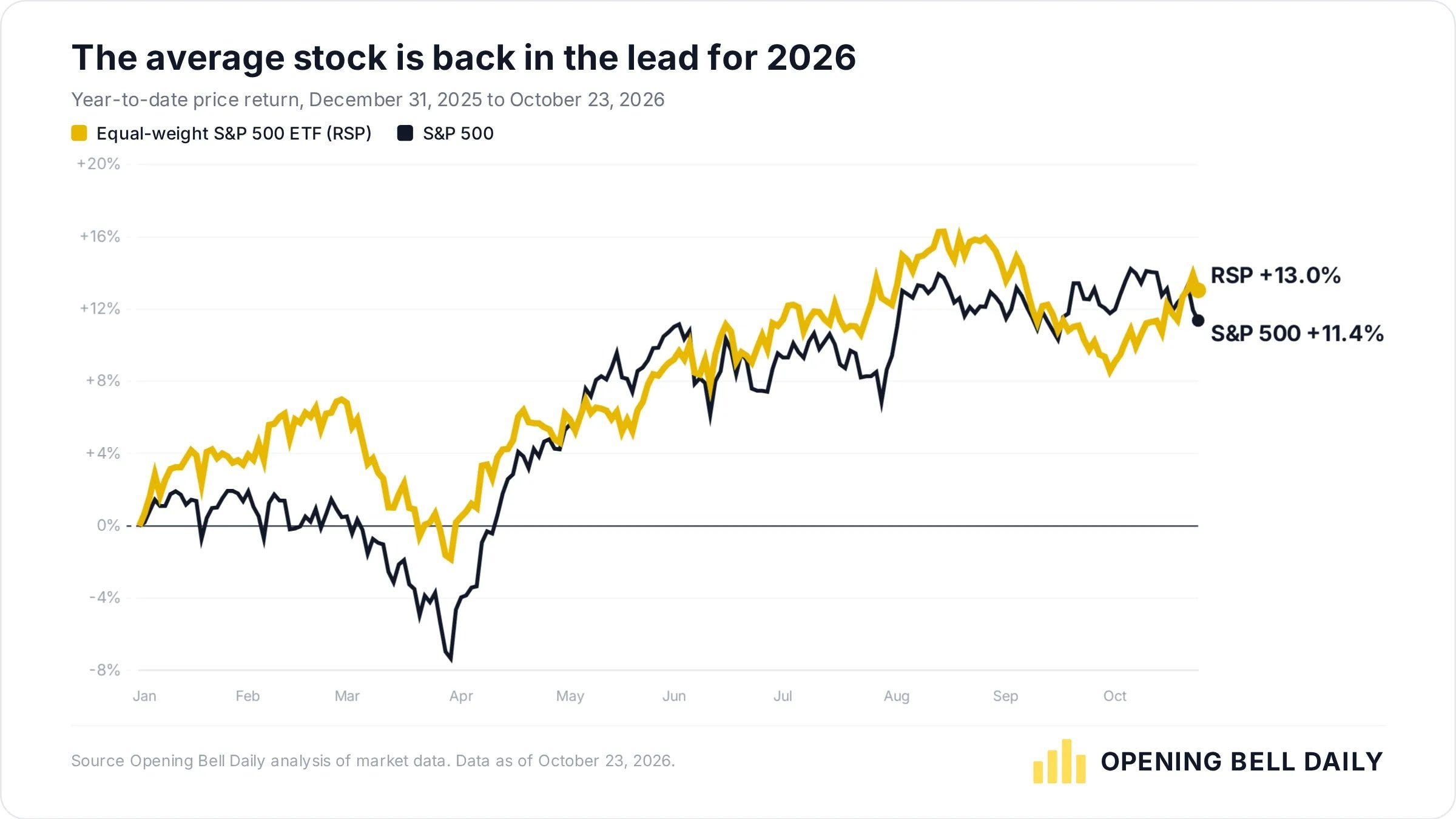
The equal-weight S&P 500 ETF was up 13.0% for the year through 23 October, compared with 11.4% for the cap-weighted S&P 500. The average stock was ahead even though several mega-cap shares had weakened.
Breadth is not uniformly strong. The share of S&P 500 companies above their 200-day moving average fell from 73.6% in August to 40.4% at the end of September. It then recovered to 55.8% by 23 October.
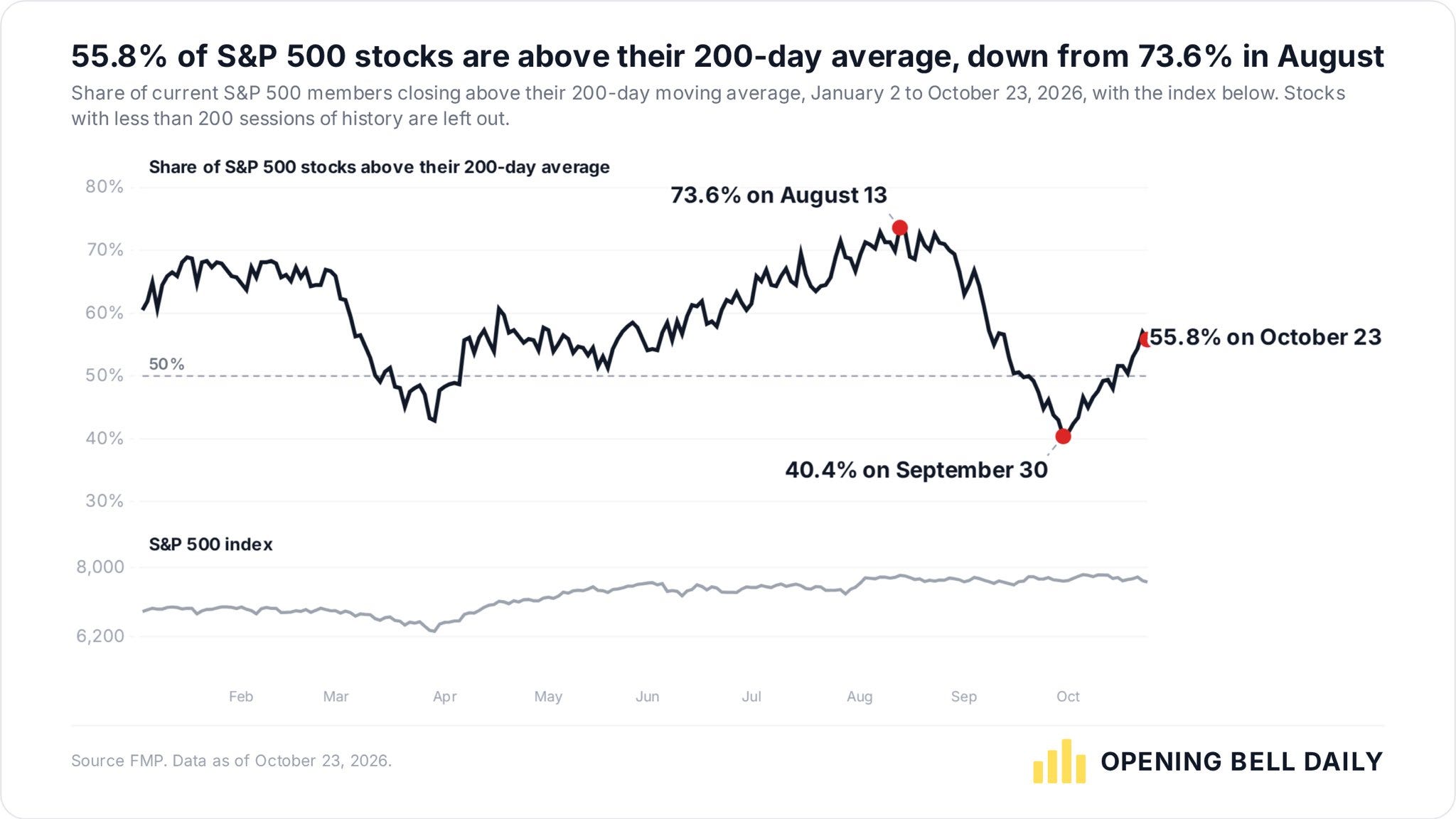
I read those two charts together. The market has broadened beyond the largest technology companies, but participation is still mixed enough to reward selectivity. This is closer to a rotation than a clean risk-on rally or a broad bear market.
That is a healthier setup for stock picking. It also means an investor who already owns the S&P 500 may have more AI exposure than the index label suggests. Adding several AI-related individual stocks can deepen the same underlying bet rather than diversify it.
November has a strong history but seasonality is not a valuation model
Since 1950, November has delivered the strongest average monthly return for the S&P 500 at about 1.9%. December has also been positive on average. The historical pattern is encouraging, particularly after a difficult October for technology shares.
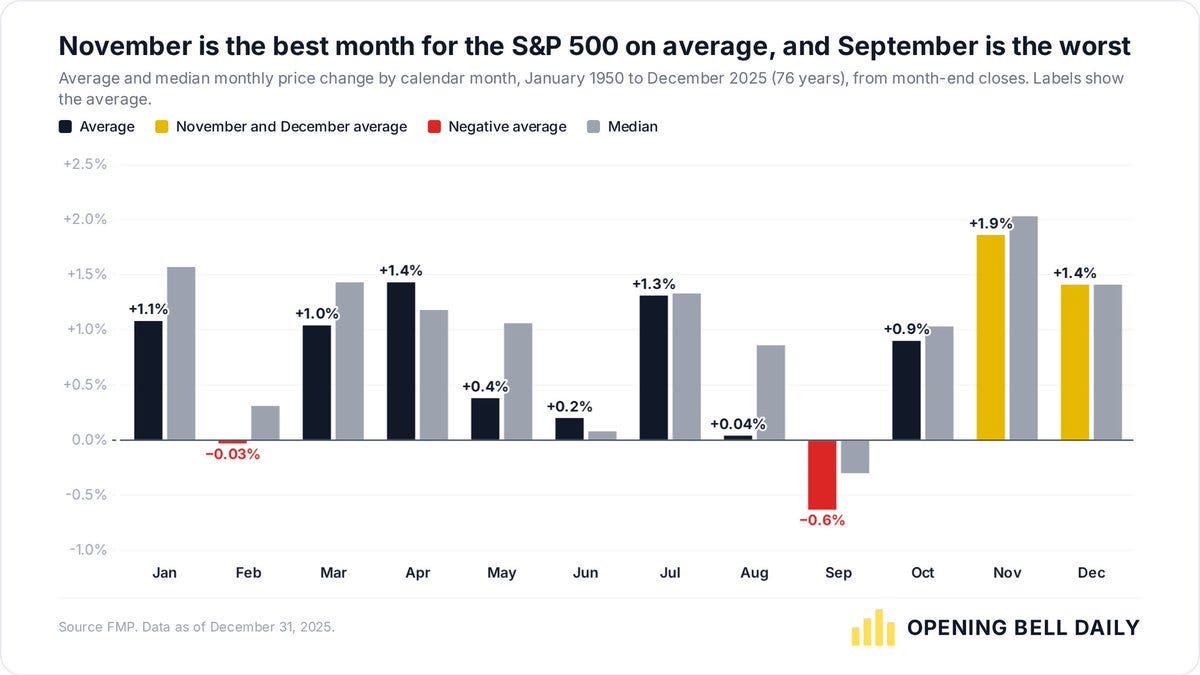
I would not buy a stock because the calendar has changed. Averages hide a wide range of outcomes, and a single earnings report can overwhelm a seasonal tendency. Seasonality is useful context for position timing, not evidence of intrinsic value.
My free market view for November
The economic and earnings backdrop is supportive enough for me to remain invested. The inflation and interest-rate backdrop is restrictive enough for me to keep valuation discipline.
My practical conclusions are straightforward.
• I would not abandon equities because a concentrated group of AI shares had a poor month.
• I would reduce unintended concentration and check how much AI infrastructure exposure already sits inside index funds and existing holdings.
• I would favour companies that can fund growth from operating cash flow and maintain strong balance sheets.
• I would use explicit entry prices instead of assuming every share below its recent high is cheap.
This free section is the framework I am using for November. If it helped you separate the market headlines from the underlying evidence, subscribe to Dividend Talks for the next Monday research note.
The anonymous valuation preview
The macro backdrop is supportive enough to remain invested, but it is not forgiving enough to abandon valuation discipline. All six finalists trade below their own five-year forward P/E averages. The size of that discount varies considerably.
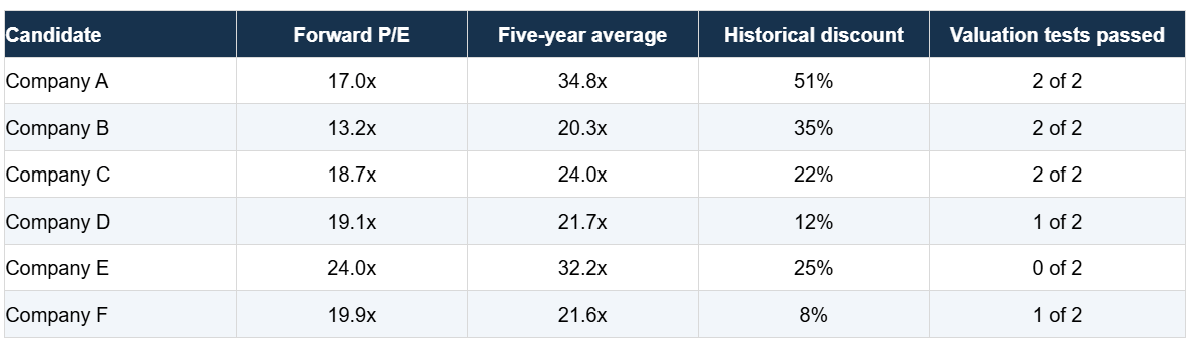
This is why a lower multiple is only the start of the work. One company trades 25% below its historical average and still fails both entry tests. Two others look undervalued in my DCF but fail the separate earnings-based entry model. Only Companies A, B and C pass both.
Paid members can continue below to reveal all six companies, see which names correspond to A, B and C, and access the complete ranking, exact DCF values, entry ceilings, downside and upside cases, company-specific risks and the 242-stock spreadsheet.