


There are certain times when a falling share price makes perfect sense.
Revenue disappoints.
Growth slows.
Margins collapse because the underlying business is deteriorating.
Customers leave.
Competition gets stronger.
Meta’s situation today is much more interesting than that.
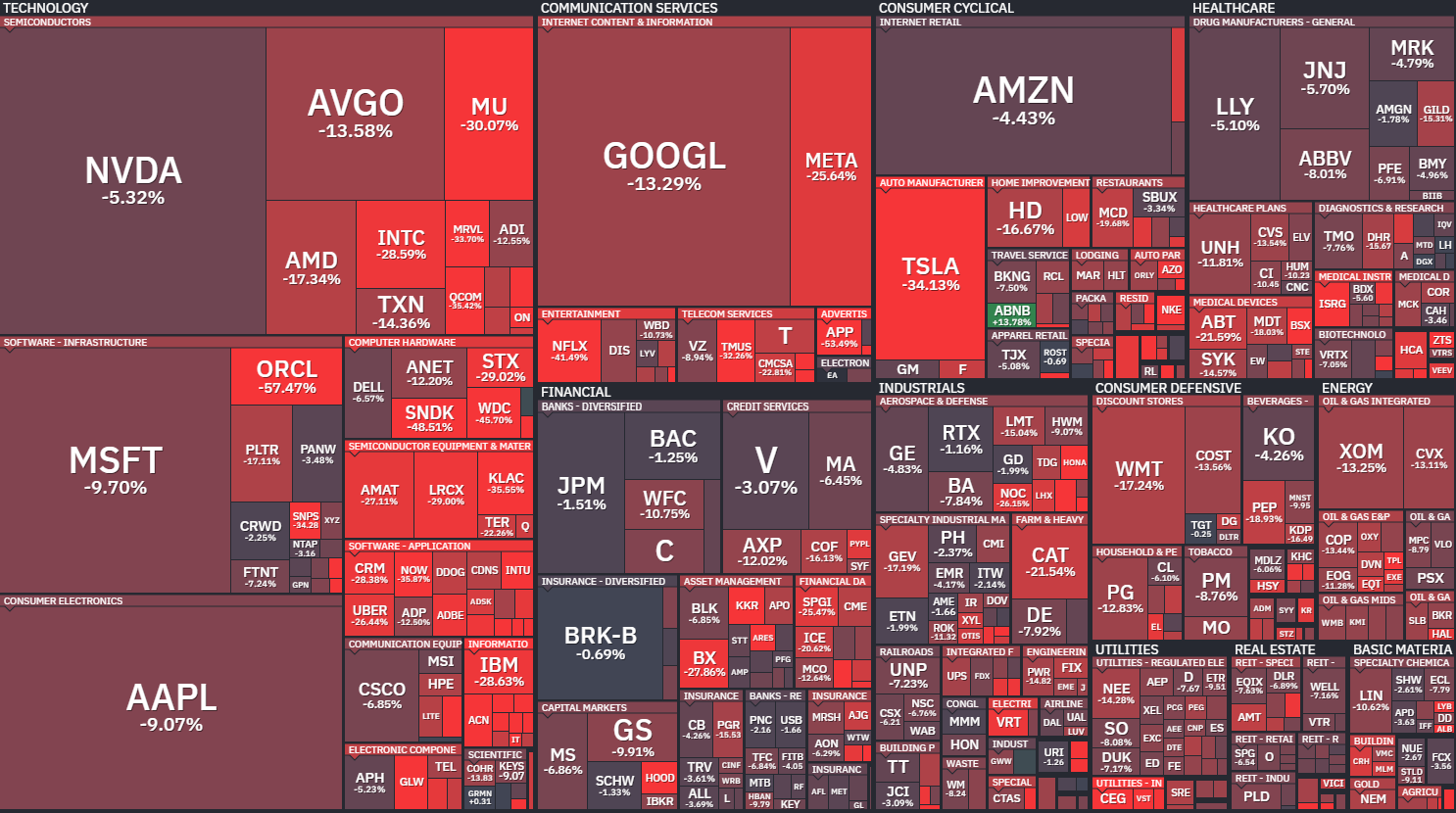
The broader market has just broken out to new highs.
Technology stocks have started moving again.
Second-quarter earnings have been incredibly strong.
Yet Meta remains roughly 25% below its recent high.
And that makes the sell-off particularly interesting.
And at the end, I’ll show you whether I think META is actually cheap at today’s price and why, despite my conclusion, I recently chose to put fresh money into another stock instead.
What’s strange is that underneath that falling share price, the actual business Meta owns is still performing exceptionally well.
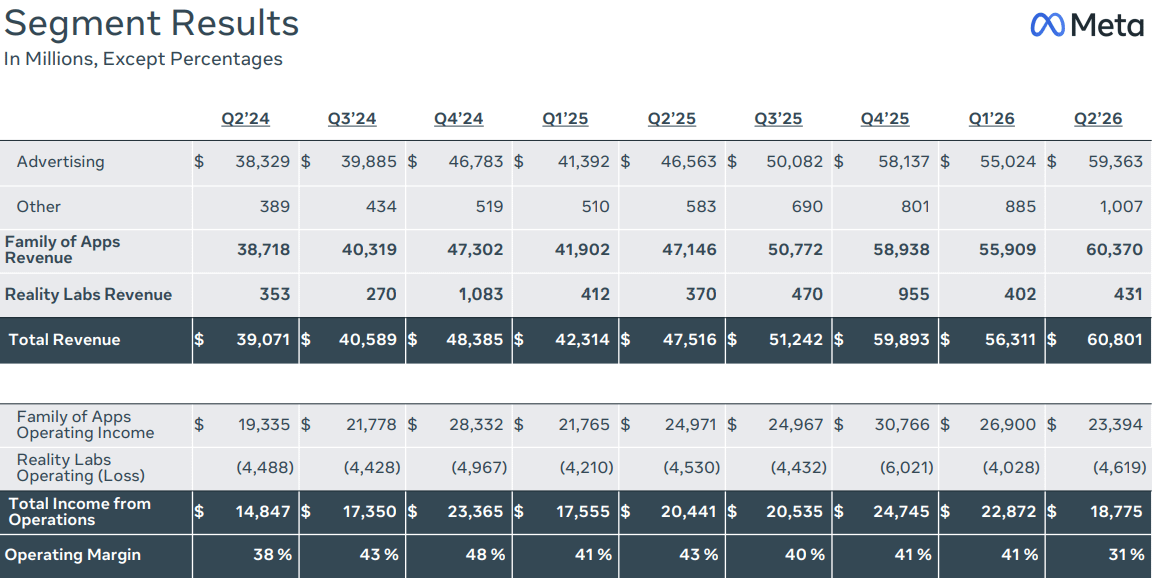
Revenue increased 28% year over year to $60.8 billion.
Advertising revenue reached approximately $59.4 billion.
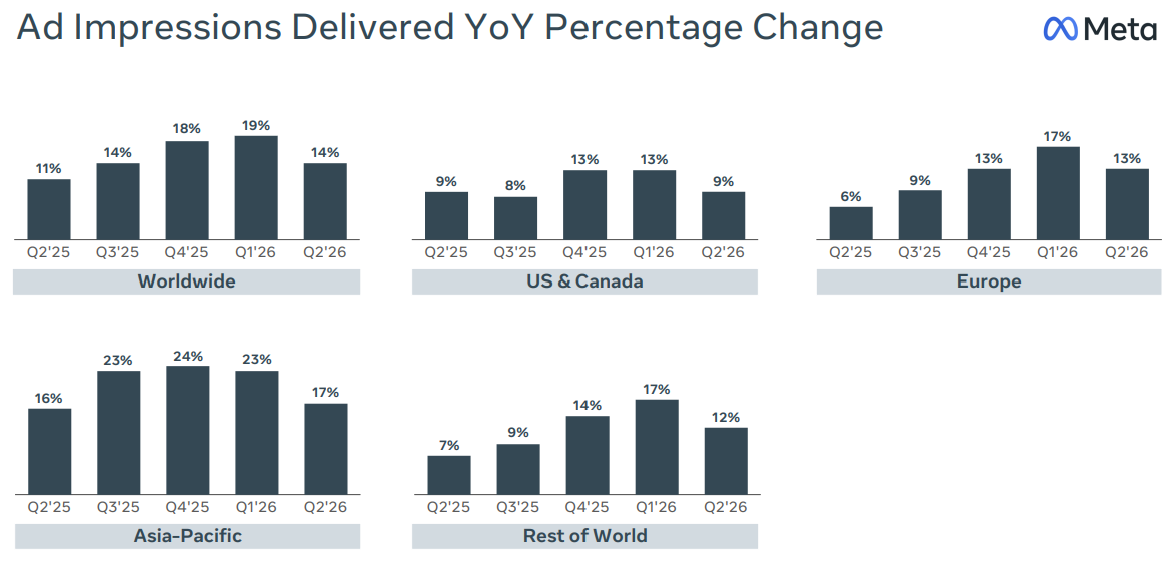
Ad impressions increased 14%.
The average price per advertisement increased another 12%.
And Meta’s Family of Apps continues to reach billions of people every single day.
These aren’t the numbers of a company whose core business has suddenly stopped working.
And that’s the first thing I think investors need to understand.
The underlying business isn’t the problem.
Meta’s advertising machine remains extraordinary.
One of the most impressive numbers from the quarter was not simply revenue growth.
It was the combination of:
Ad impressions: +14%
and
Average price per ad: +12%
That is a very powerful combination.
Meta is serving more advertising inventory while advertisers are simultaneously paying more for that inventory.
And AI is already contributing here. Better recommendations can drive engagement and advertising inventory, while better targeting and creative tools can improve advertiser returns. If advertisers generate better returns on Meta's platforms, Meta ultimately has more room to monetise that value.
This is important because Meta does not need to invent some completely new AI business before AI can create economic value.
AI is already improving the business that pays the bills.
But impressions are only one side of the equation.
The other side is pricing.
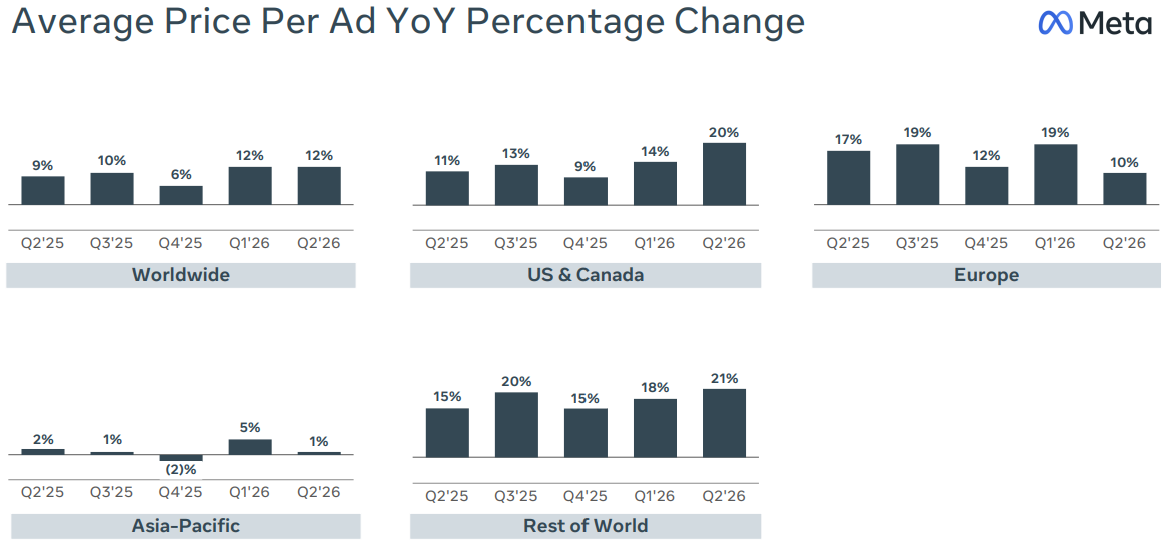
When you can simultaneously increase volume and pricing, the economics become extremely powerful.
And we can see the result directly in advertising revenue.
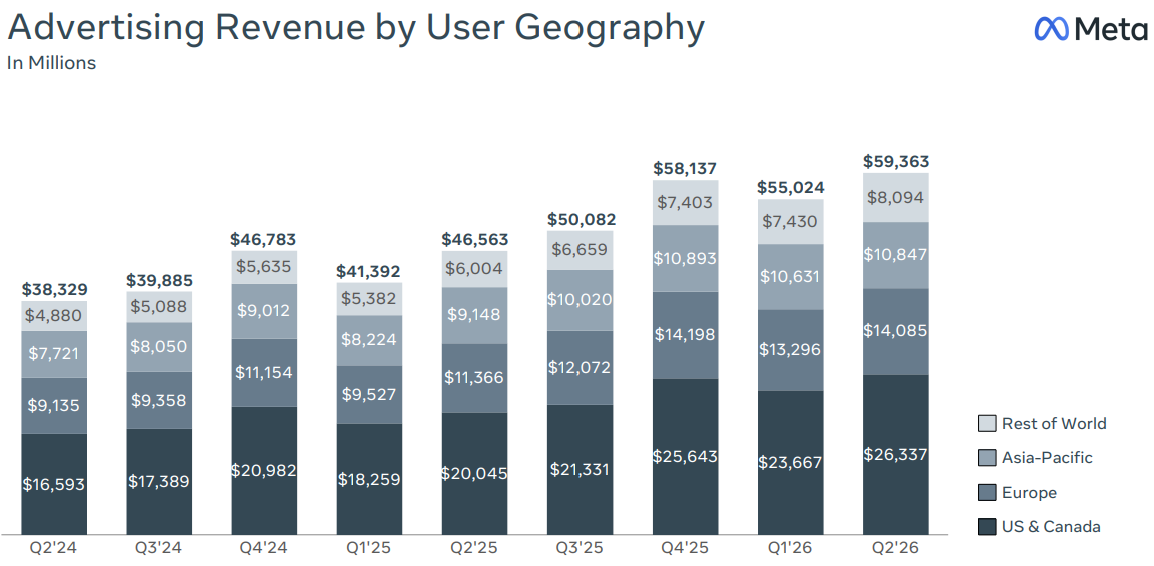
This is why I’m reluctant to describe Meta as a broken investment simply because the stock is falling.
The advertising engine isn’t collapsing.
Quite the opposite.
So why did investors react so badly?
Enjoying the deep dive? I publish research like this regularly, including valuation models, earnings analysis and the stocks I’m personally watching and buying.
Why Is META Being Punished?
The answer can be summarised in one word.
Spending.
Meta’s reported costs and expenses increased 55% year over year.
But there is some important context here. Q2 included $2.4 billion of legal charges and $1.18 billion of severance expenses, so I would not treat that entire increase as structural.
The cleaner concern for me is capital intensity.
Meta spent approximately $31.1 billion on capital expenditure in Q2 alone, and management now expects $130–145 billion for the full year.
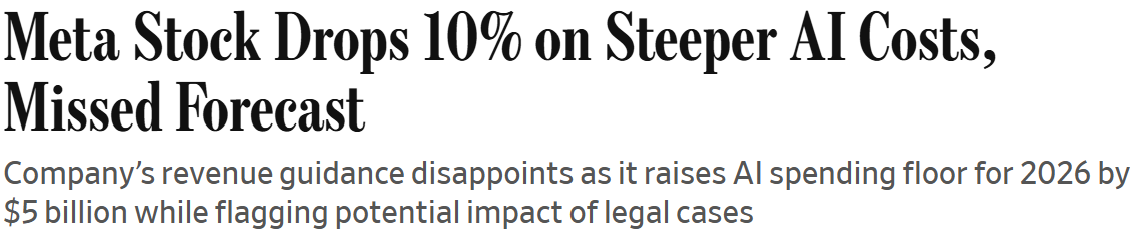
That headline gets directly to the problem.
The market didn’t punish Meta because advertisers suddenly stopped spending.
It punished Meta because investors are increasingly asking:
How much money is Zuckerberg going to spend before shareholders can see the return?
And the acceleration has been enormous.
A year earlier, quarterly capex was roughly $17 billion. Today, it’s more than $31 billion.
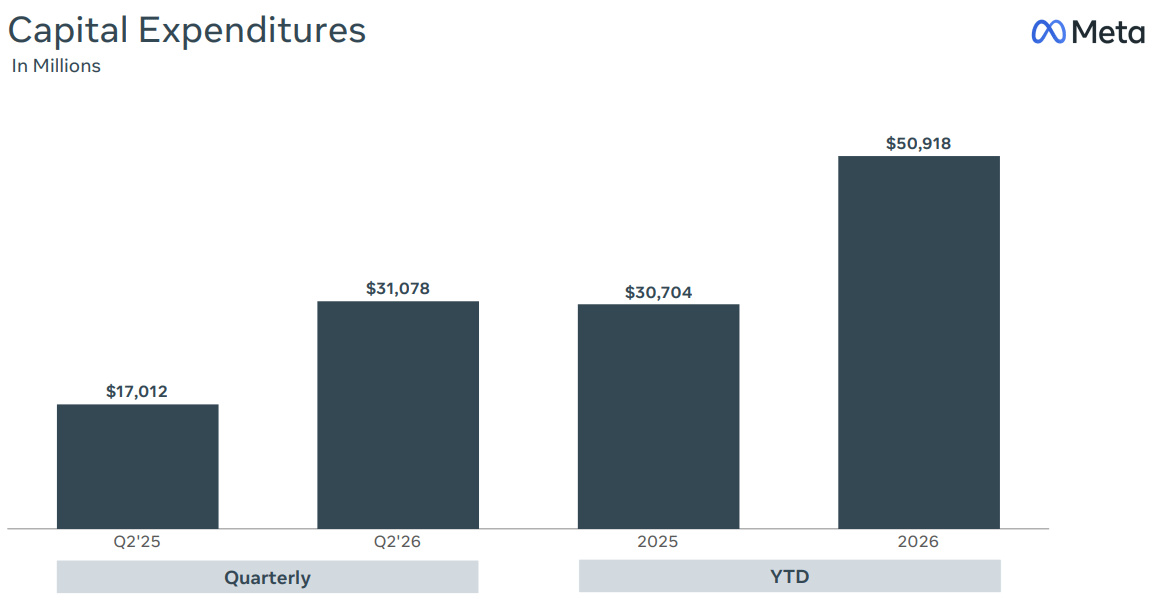
That’s almost a doubling in twelve months.
But even that chart doesn’t fully communicate how dramatic the shift has been.
Look at Meta’s quarterly spending over a longer period.
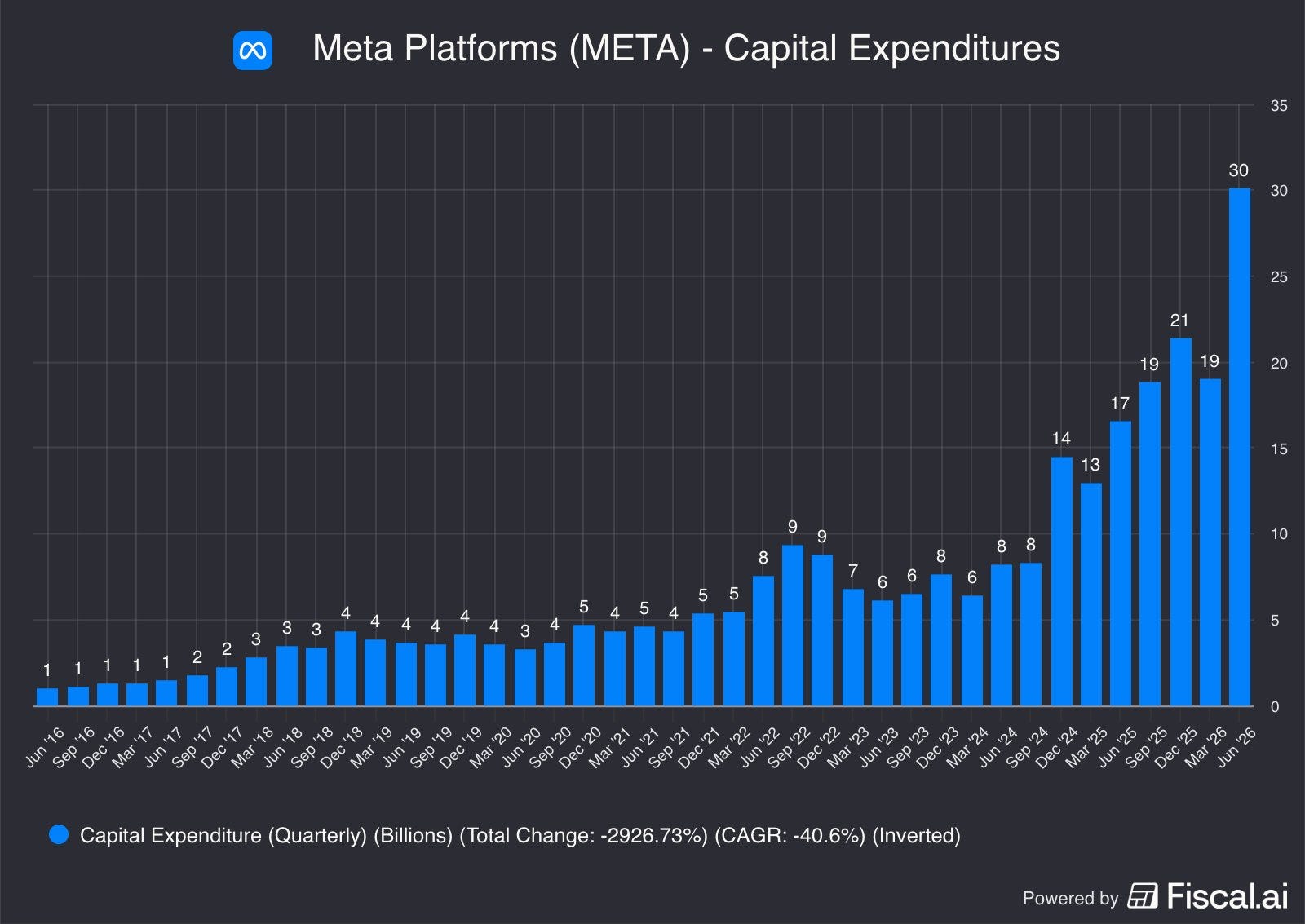
That is the chart that really changes the investment case.
For most of Meta’s history, this was an enormously scalable digital advertising platform.
Today, we’re increasingly analysing it like an infrastructure company as well.
Data centres.
GPUs.
Networking.
Energy.
Custom silicon.
Training.
Inference.
And potentially hundreds of billions of dollars of additional infrastructure over the coming years.
But Meta isn’t alone.
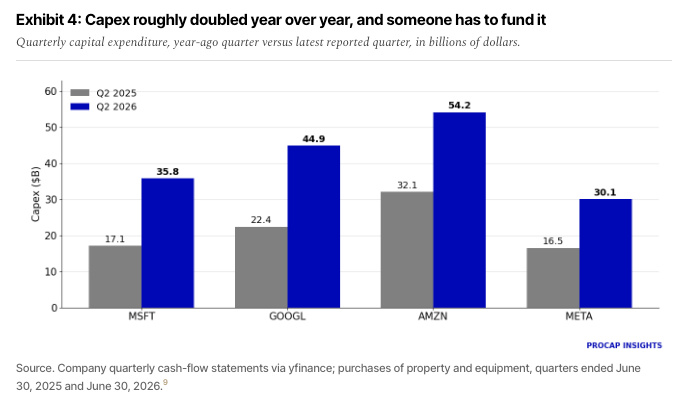
This is an industry-wide AI arms race.
But I think Meta faces a slightly more uncomfortable question than several of its peers.
Microsoft has Azure.
Amazon has AWS.
Google has Google Cloud.
Those businesses provide investors with relatively visible ways of connecting infrastructure investment with paying external customers.
Meta’s situation is different.
Its advertising business generates enormous amounts of cash.
But the relationship between spending another $50 billion on AI infrastructure and receiving another $50 billion of incremental future cash flow is much harder to see.
And that’s why the market has become more demanding.
The Market Now Wants Proof
There was a time when simply announcing more AI spending was enough to excite investors.
I don’t think we’re in that market anymore.
Investors increasingly want evidence that the capital being deployed will eventually produce attractive returns.
And Meta has found itself right in the centre of that debate.
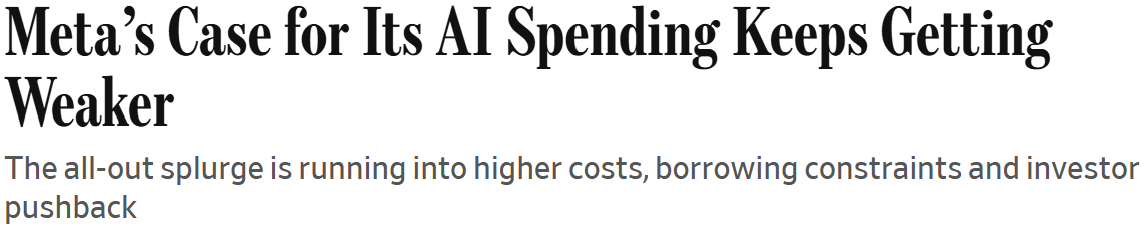
I don’t completely agree with that headline.
But I understand why it exists.
Because this isn’t ultimately a debate about whether Meta can afford $130–145 billion of annual capex.
It can.
The advertising machine is extraordinarily profitable.
The balance sheet is strong.
The question is whether shareholders receive an attractive return on that capital.
And to understand why investors care so much, we need to follow the cash.
Free Cash Flow Has Become the Number That Matters
Meta can produce fantastic accounting earnings while simultaneously producing much weaker free cash flow.
That’s exactly what infrastructure spending does.
It doesn’t necessarily mean the business is deteriorating.
But it does change what shareholders receive today.
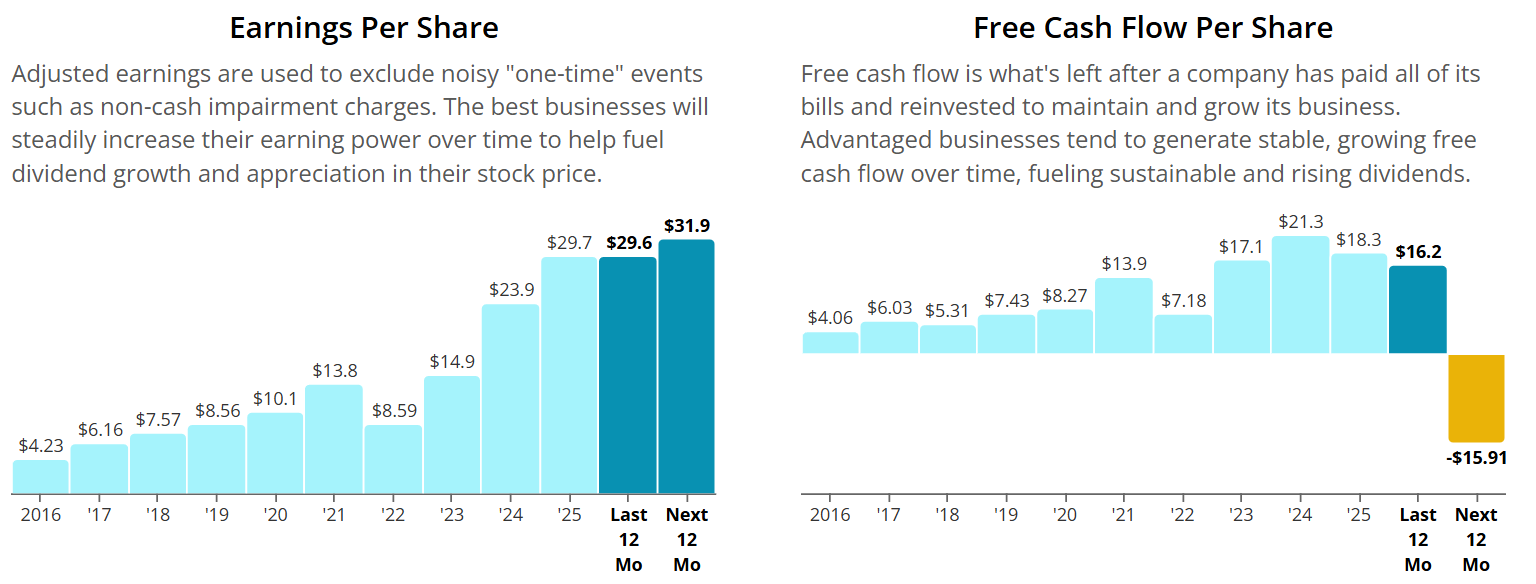
That chart captures the contradiction.
Earnings aren’t disappearing. Cash available after investment is.
And that distinction matters enormously for valuation. A company can grow revenue, EPS and operating profit and still disappoint shareholders if sustaining that growth requires continually reinvesting an ever-larger amount of cash.
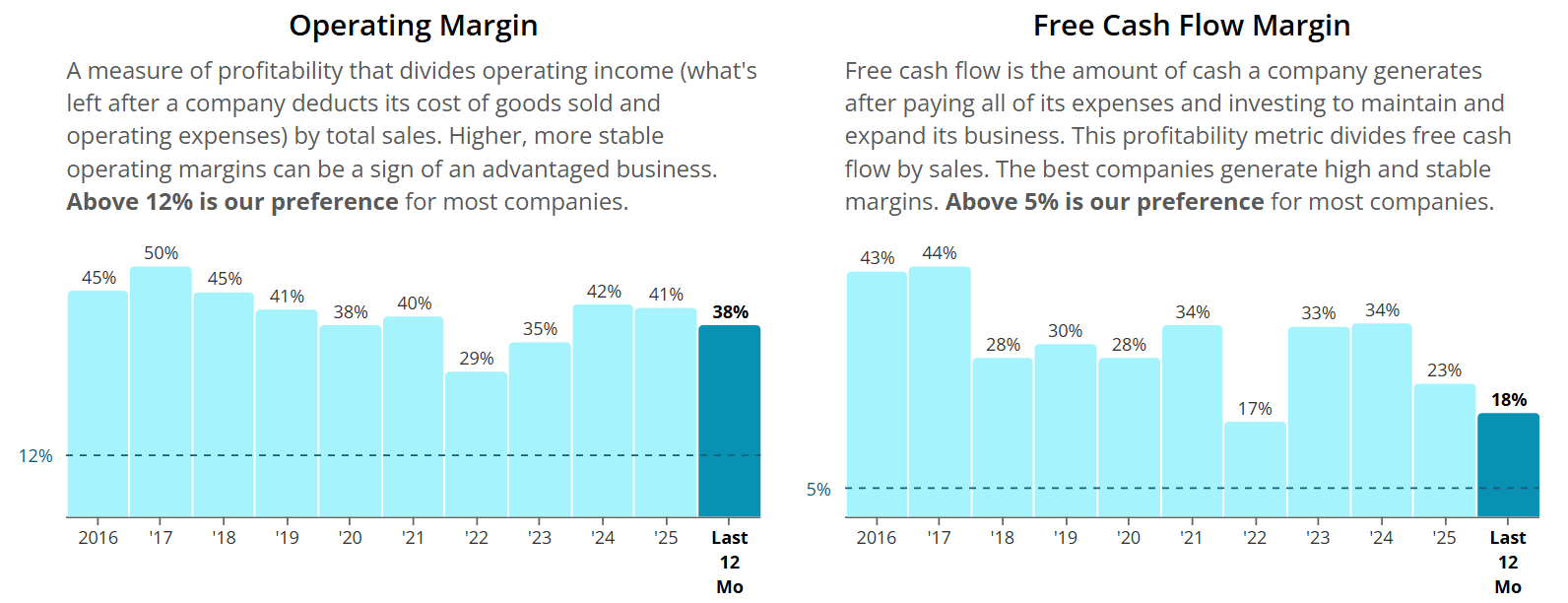
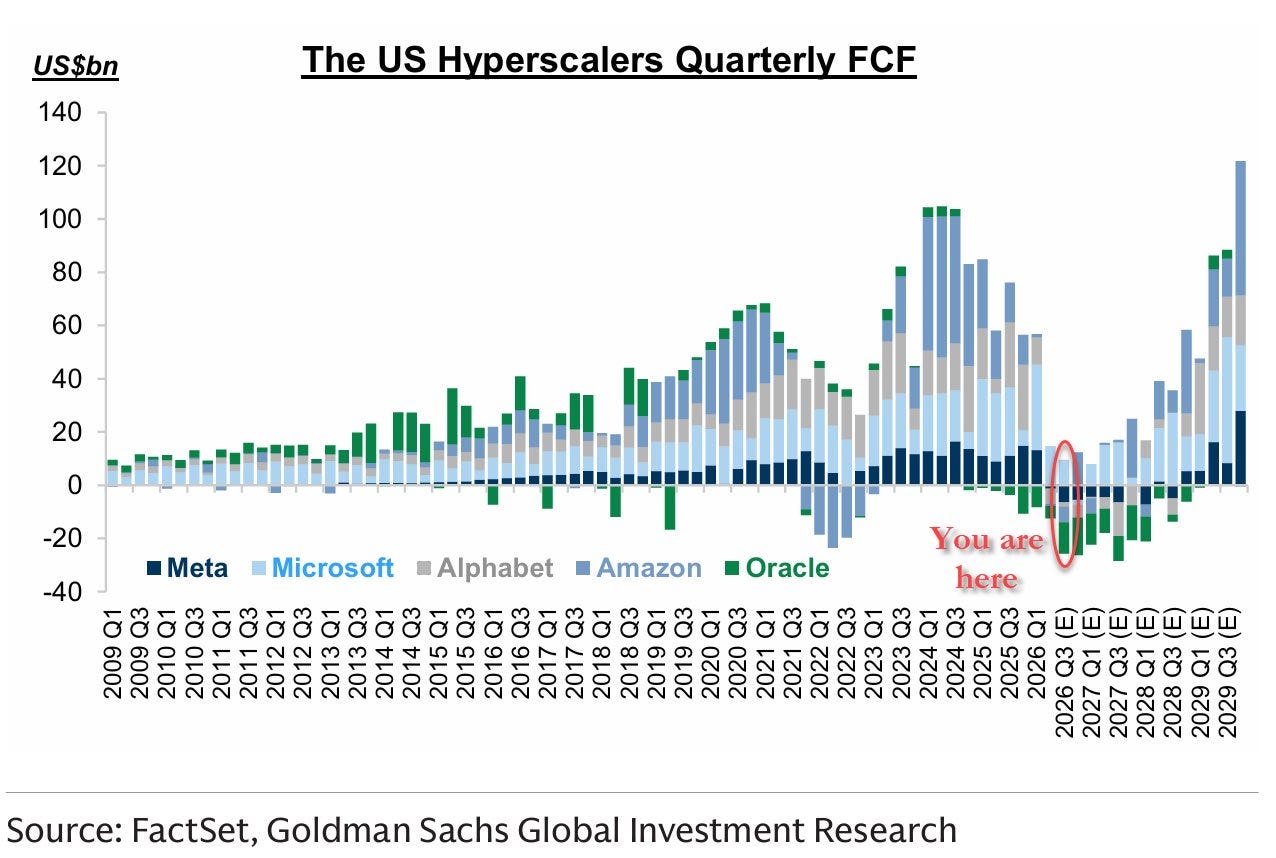
That chart is important because it puts the current period into context.
This isn’t simply a META problem.
The entire hyperscaler complex is sacrificing enormous amounts of near-term free cash flow to build AI infrastructure.
The optimistic interpretation is straightforward:
Free cash flow is temporarily depressed because these companies are making investments that generate much greater cash flow later.
The pessimistic interpretation is equally straightforward:
The infrastructure is enormously expensive and the eventual economic returns may not justify what is being spent.
Meta’s valuation depends heavily on which one proves correct.
If you know someone trying to work out whether Big Tech’s AI spending is a temporary cash-flow trough or a permanent return problem, send them this analysis.
But What If Meta Has Built Too Much Compute?
This is where the story becomes much more interesting.
Because if Meta builds more compute than it ultimately needs internally, that doesn’t necessarily mean the investment becomes worthless.
There could be an external market for that infrastructure.
And Meta itself has acknowledged that demand for compute is extremely strong.
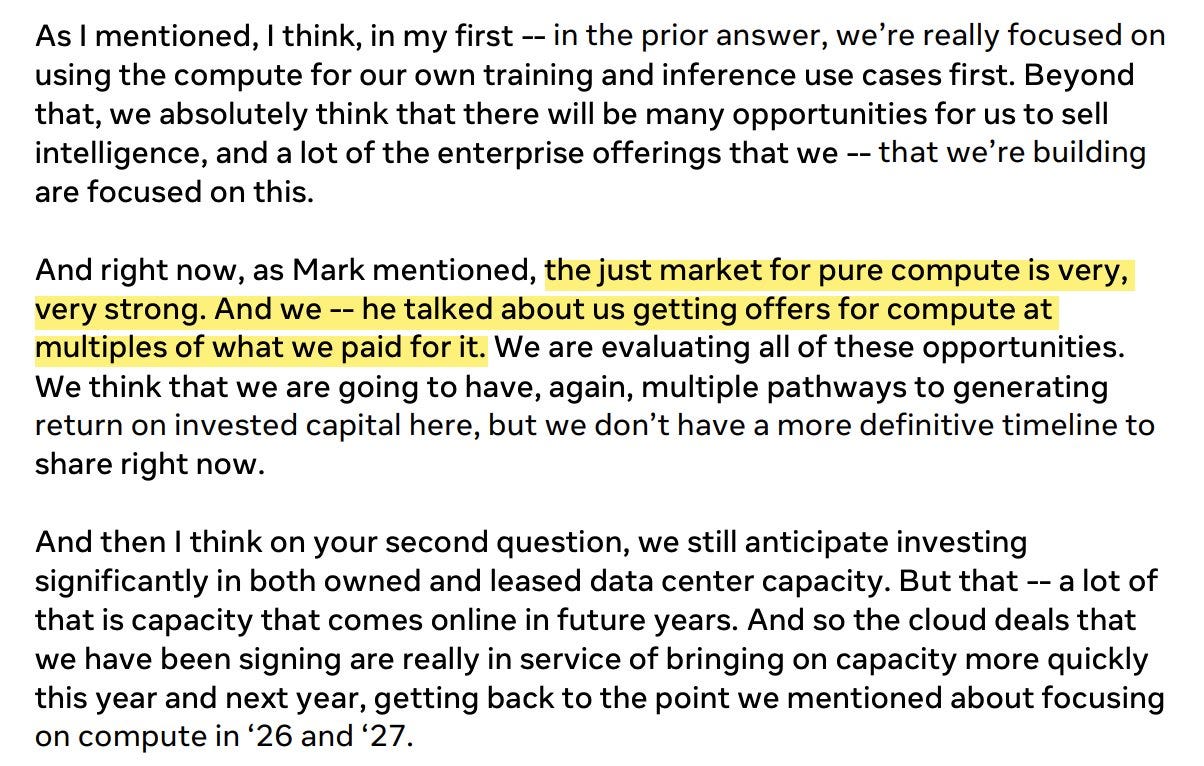
That doesn’t mean I am suddenly putting an AWS-sized Meta Cloud business into my valuation.
I absolutely am not.
But it does give the infrastructure optionality.
If Meta needs all of that compute internally, great.
If it eventually discovers that part of the infrastructure can generate attractive third-party revenue, that creates another monetisation route.
And that becomes particularly interesting because Meta is also starting to broaden the ways it monetises AI directly.
Meta Finally Has More Than One AI Monetisation Path
This is where the bull case has become much more interesting to me.
For years, the criticism was obvious: Meta was spending billions building AI without giving investors a particularly clear route towards direct monetisation.
That is starting to change.
There has been discussion around paid AI functionality across Meta’s consumer ecosystem, while Meta is also building products that developers and businesses can potentially pay to use.

I’m not saying those products justify today’s spending. They don’t, not yet.
But Meta also has one advantage that very few AI companies can replicate: distribution.
A startup can build an incredible AI product and still need to acquire users. Meta already owns Facebook, Instagram, WhatsApp and Messenger. If it develops a compelling AI product, it potentially has billions of existing users to distribute it to.
That doesn’t guarantee success.
But it dramatically changes the potential economics.
The Bear Case Still Isn’t Crazy
I don’t want the article to become an exercise in explaining away every risk.
Because there are legitimate reasons the market is sceptical.
Meta itself has acknowledged that its current models are not yet at the level of the leading frontier models.
In the interview material we reviewed for the video, Meta’s AI leadership described Muse Spark as an early point on the scaling path rather than a finished frontier-leading product.
That is the uncomfortable part.
If you’re spending at this scale, simply being competitive isn’t enough.
Meta needs to create enormous economic value.
Because the cost of being wrong has become very large.
Meta is spending like an AI leader.
Now it has to prove that it can generate the economics of one.
And that uncertainty is exactly why I don’t think one valuation scenario is enough.
There Is Another Risk Investors Shouldn’t Ignore
Most investors look at Meta’s legal problems, see a fine of several hundred million dollars or even around $1 billion, and understandably conclude:
Meta can afford that.
They’re right.
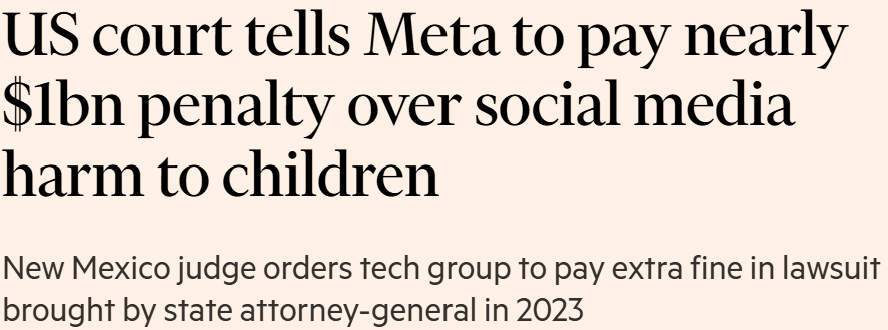
The fine itself isn’t what concerns me most.
Meta can financially absorb even very large penalties.
The bigger risk would be regulation that changes how its products work.
Meta’s moat isn’t simply that billions of people have Instagram or Facebook. It’s also Meta’s ability to keep those users engaged through personalised recommendations and product design.
If regulation materially limits those engagement mechanisms, the potential chain is straightforward:
lower engagement → fewer impressions → weaker advertising monetisation.
I’m not modelling a catastrophic regulatory outcome in my base case. But that risk matters far more to me than the headline dollar amount of an individual fine.
And Yet META Isn’t Expensively Priced
This is the part that makes the whole situation compelling.
If Meta were trading at 35 or 40 times forward earnings while all of this uncertainty existed, I wouldn’t find the risk/reward particularly attractive.
But it isn’t.
Consensus estimates show Meta’s earnings multiple falling considerably over the next several years if earnings expectations are achieved.
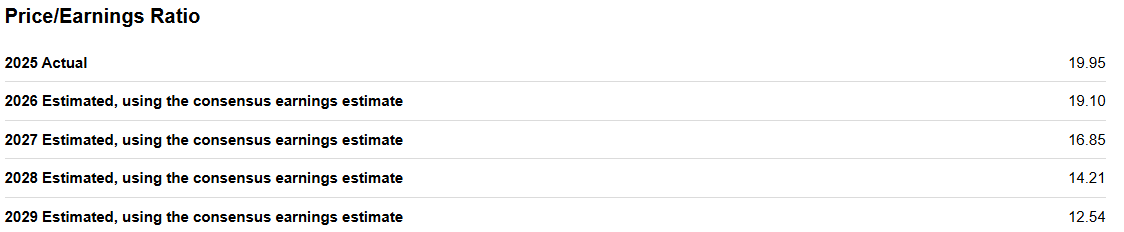
Obviously those earnings estimates aren’t guaranteed.
But the important point is that Meta isn’t being priced as if every part of the AI strategy works perfectly.
That becomes even clearer when we compare it against some of the other mega-cap technology companies.
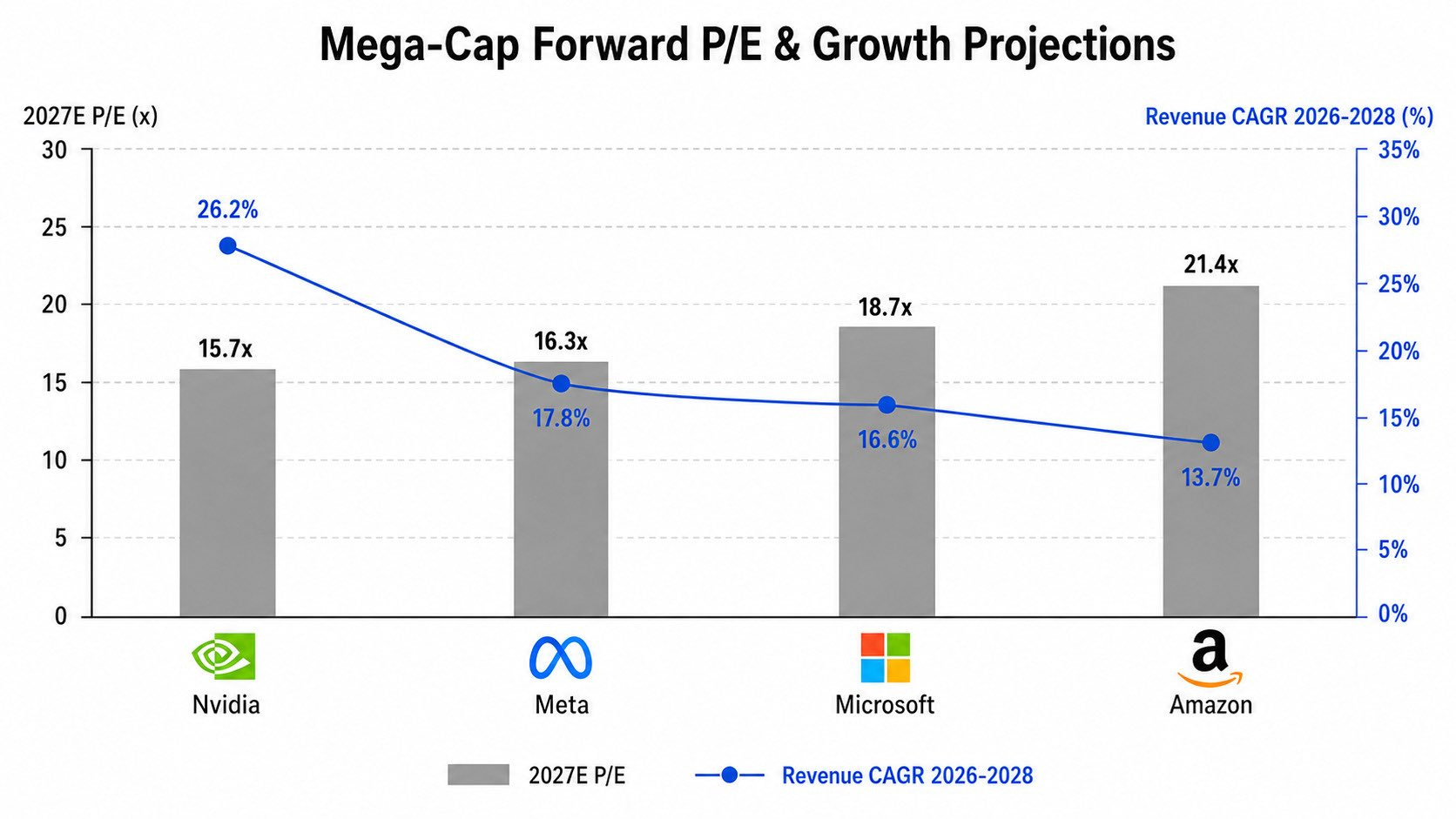
That doesn’t automatically make Meta cheap.
But it does mean the valuation is beginning to reflect meaningful uncertainty.
And that’s the point where I stop looking at headlines and start looking at cash flow.
So What Is META Actually Worth?
I don’t think anybody can confidently tell you exactly how profitable Meta’s AI infrastructure will ultimately become.
So I don’t want to pretend I can.
Instead, I’ve modelled three different outcomes.
And importantly, I’m not just changing random assumptions until I get whatever valuation I want.
The major variable is the one that I think matters most:
How much free cash flow can Meta ultimately generate once this investment cycle matures?
My three scenarios produce three completely different answers.
🐻 Scenario 1: AI Disappoints
Let’s start with the bear case.
And again, this isn’t a Meta-collapse scenario.
Facebook doesn’t disappear.
Instagram doesn’t become irrelevant.
Advertisers don’t suddenly leave.
The advertising business remains highly profitable.
But the extraordinary AI investment fails to create an equally extraordinary new source of cash flow.
Meta improves recommendations.
It improves advertising.
Some AI products gain adoption.
But the company never earns the sort of returns that would fully justify the scale of the capital deployed.
Capex remains structurally elevated.
Depreciation rises.
Cash conversion remains weaker.
And Meta effectively becomes a more capital-intensive version of the company investors owned historically.
In that scenario, I model free cash flow reaching approximately:
$65 Billion by 2030
That gives me an estimated intrinsic value of roughly:
$501 Per Share
At around $592 today, that represents approximately:
15% Downside
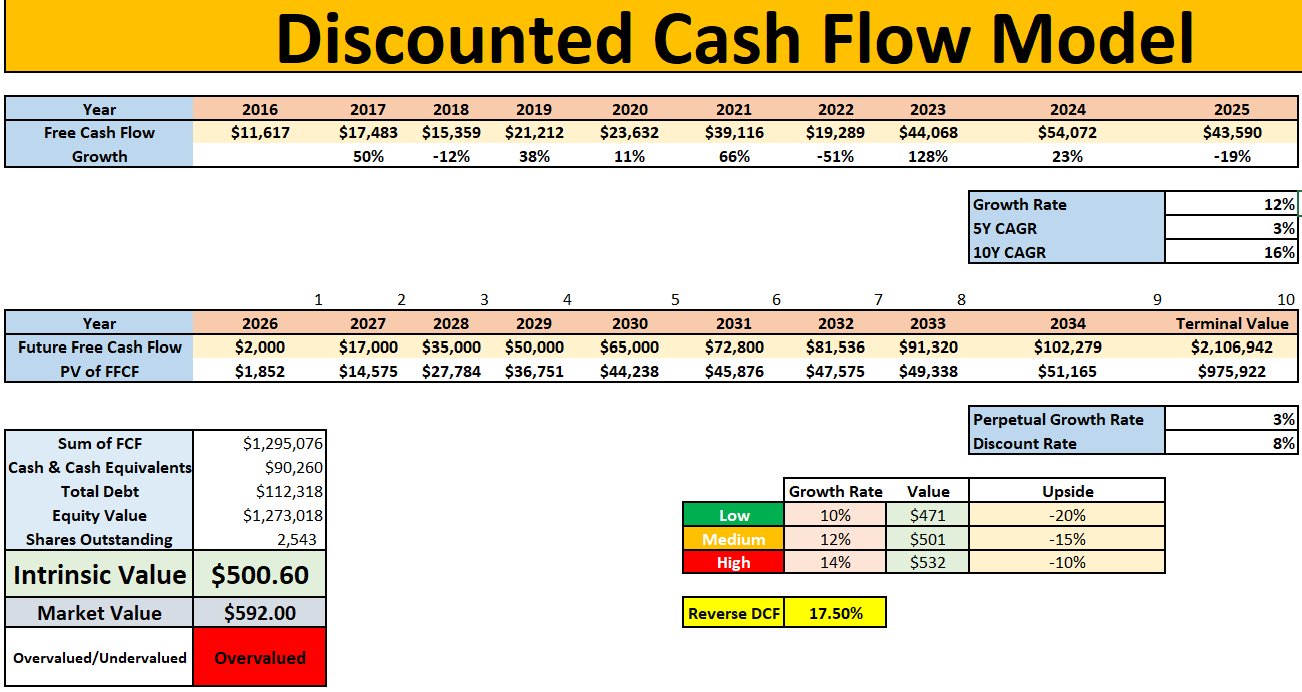
This is why I’m not comfortable saying:
Meta has fallen, therefore Meta is automatically cheap.
If Zuckerberg earns poor returns on this investment, there is still downside.
And that is a very real scenario.
But it’s not the scenario I think is most likely.
⚖️ Scenario 2: My Base Case
My base case is much less dramatic.
My base case doesn’t require Meta to dominate AI, build the next AWS or become the world’s leading model provider.
What it does require is that Meta earns a reasonable return on the money it is spending.
The core advertising business keeps compounding.
AI continues improving engagement.
Advertisers receive better returns.
Meta gradually develops additional monetisation from models, agents, subscriptions and developer products.
And eventually:
Cash-flow growth begins to outpace infrastructure growth.
Under that scenario, I model free cash flow reaching approximately:
$95 Billion by 2030
That produces my current base-case valuation of:
$734 Per Share
Against approximately $592 today, that’s roughly:
24% Upside
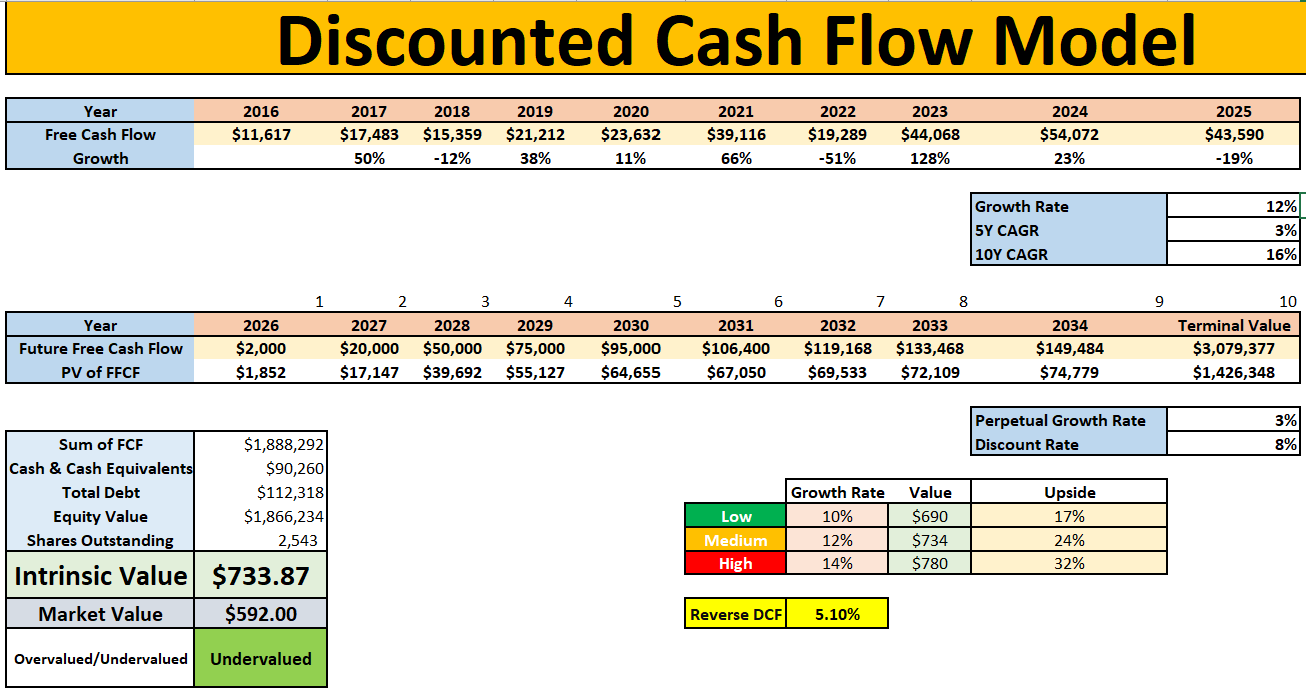
This is the scenario I currently find most reasonable.
And what I like about it is that I don’t need some heroic AI outcome to justify today’s share price.
I need one of the world’s best advertising businesses to continue compounding while management earns a sensible return on the enormous amount of money currently being deployed.
I think that’s achievable.
🐂 Scenario 3: Zuckerberg Is Right
And then we have the scenario where today’s spending looks almost absurdly cheap in hindsight.
Imagine the existing advertising engine keeps compounding.
AI recommendation systems substantially increase engagement.
AI advertising tools materially improve advertiser returns.
Meta AI becomes one of the world’s major consumer AI products.
Agents become useful.
Developer products generate meaningful revenue.
Subscriptions work.
AI glasses become important.
And part of Meta’s enormous compute footprint becomes externally monetisable.
Suddenly we’re no longer talking about AI merely defending Facebook and Instagram.
AI becomes Meta’s next major business.
In that world, I can see Meta eventually producing approximately:
$135 Billion of Free Cash Flow by 2030
And under the same underlying valuation methodology, that gives me an intrinsic value of roughly:
$1,040 Per Share
Against approximately $592 today:
~76% Upside
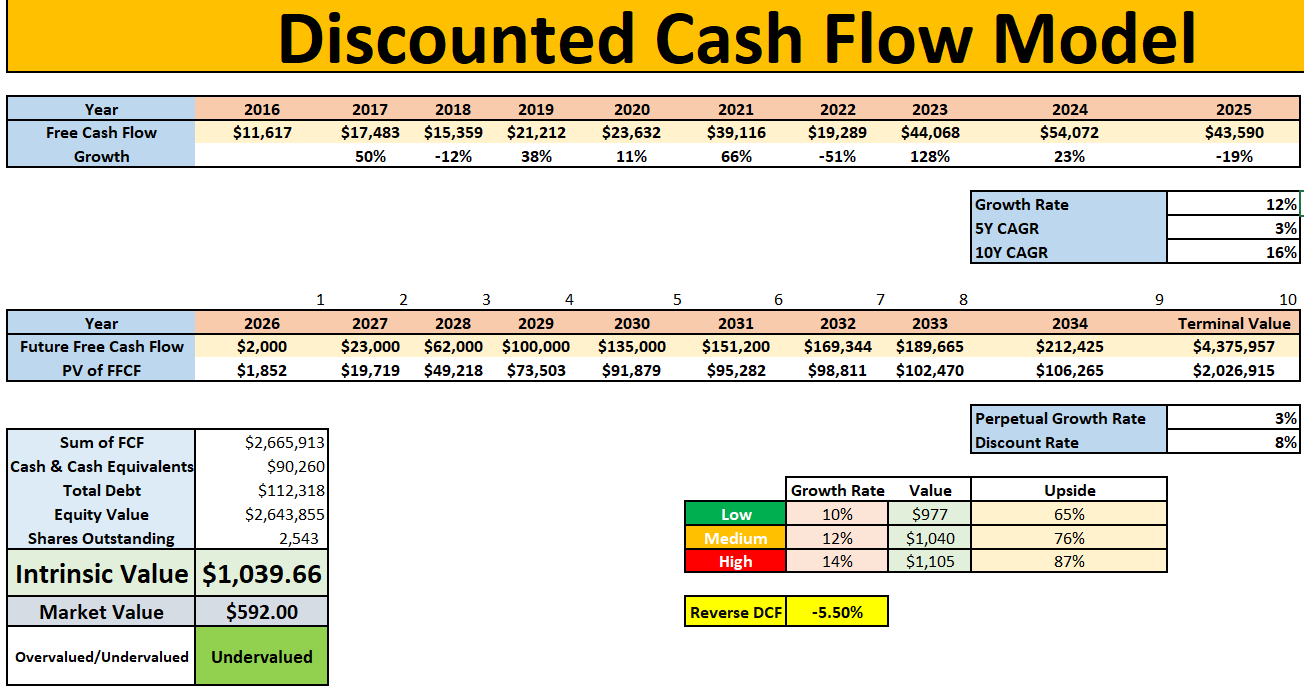
Do I think investors should simply assume this happens?
No.
Absolutely not.
There is far too much execution risk for that.
But I also don’t think the scenario is ridiculous anymore.
Meta has:
the users
the distribution
the advertising machine
the capital
the infrastructure
and increasingly:
actual routes towards AI monetisation.
The big unanswered question is whether those pieces eventually create enough free cash flow.
My Three Scenarios

And that’s really the entire META debate in one table.
The advertising business can remain excellent in all three scenarios.
The difference is what happens to the enormous amount of cash Zuckerberg is investing today.
So Am I Buying META?
After going through all of this again, my view is fairly simple.
I think META is undervalued.
But I also don’t think the bear case is stupid.
There is a legitimate scenario where Meta remains an extraordinary company while simultaneously becoming a less attractive investment because the returns on incremental capital aren’t high enough.
That distinction matters.
An amazing company is not automatically an amazing stock at every price.
At the other extreme, I’m not anchoring myself to $1,040 and assuming Zuckerberg gets everything right.
That would be equally dangerous.
My conclusion remains in the middle.
My current base-case valuation is approximately $734 per share.
At around $592, I think that gives investors an attractive margin between price and value.
And crucially, that conclusion does not require me to ignore the capex issue.
Quite the opposite.
The capex issue is why I built three scenarios in the first place.
I think investors make a mistake when they choose one extreme.
Either:
“Zuckerberg always wins, so ignore the spending.”
Or:
“Free cash flow collapsed, so Meta’s AI strategy is a disaster.”
Neither is good enough.
Meta remains one of the best digital advertising businesses ever created.
AI is already improving parts of the existing business.
But shareholders are simultaneously funding one of the largest investment cycles in corporate history.
And over the next few years, I think one number will tell us whether today’s buyers were right:
Free Cash Flow.
If cash flow rebounds aggressively as these investments mature, META at around $592 could look exceptionally cheap in hindsight.
If it doesn’t?
The market’s concern today will have been justified.
For now:
I lean towards bargain, not value trap.
But there’s an important difference between believing Meta is undervalued…
…and deciding where I personally want to put fresh money today.
Recently, I had exactly that decision to make.
I could have added more META.
I didn’t.
Instead, I put fresh money into another company.
And I think the gap between what the market currently fears and what the underlying business is actually delivering is even more attractive than the opportunity I see in META.
🔒 The Stock I Actually Bought Instead
Below, I’m breaking down why I bought it, why I chose it over adding to META, what I think the market is getting wrong, my valuation, the biggest risk to my thesis, and the price where I’d buy even more.