

The latest 13F filings are in.
And some of the world’s most closely followed investors have been putting fresh money to work.
Bill Ackman opened several entirely new positions.
Berkshire Hathaway made a huge move into Alphabet.
David Tepper added aggressively to some of the market’s biggest technology names.
Pat Dorsey increased several positions by 40%, 60% and even 80%.
And Terry Smith reshaped a sizeable portion of his portfolio.
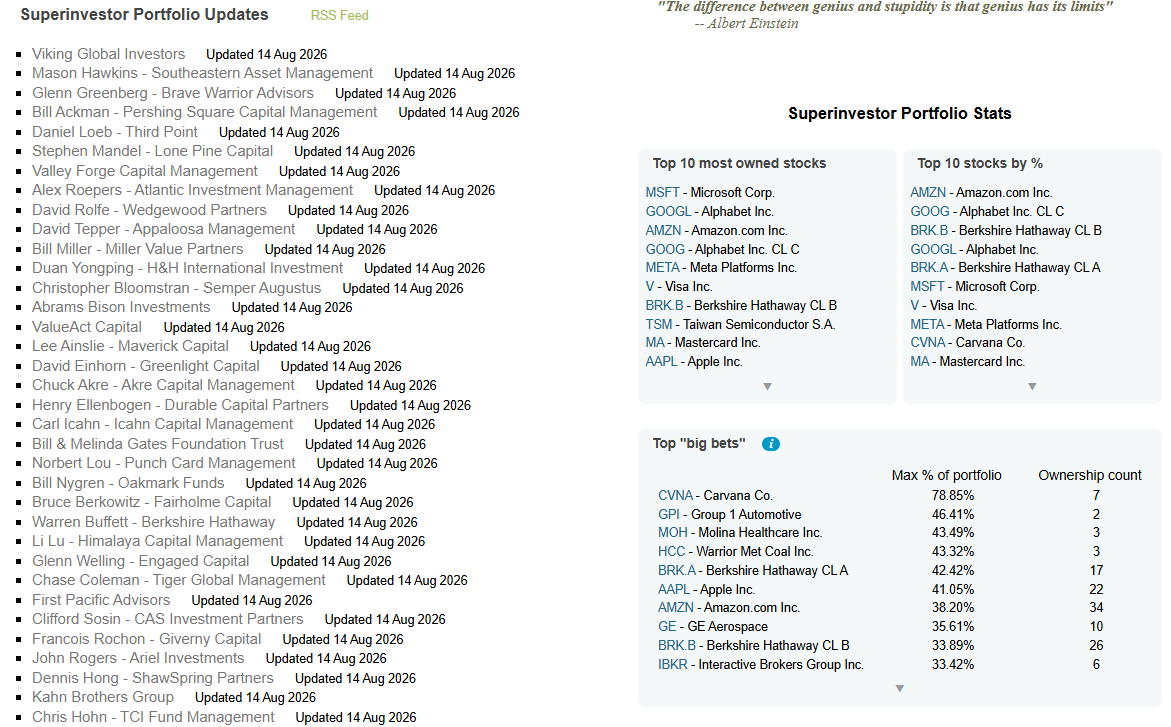
Superinvestor Portfolio Updates
But there is a problem with simply copying any of them.
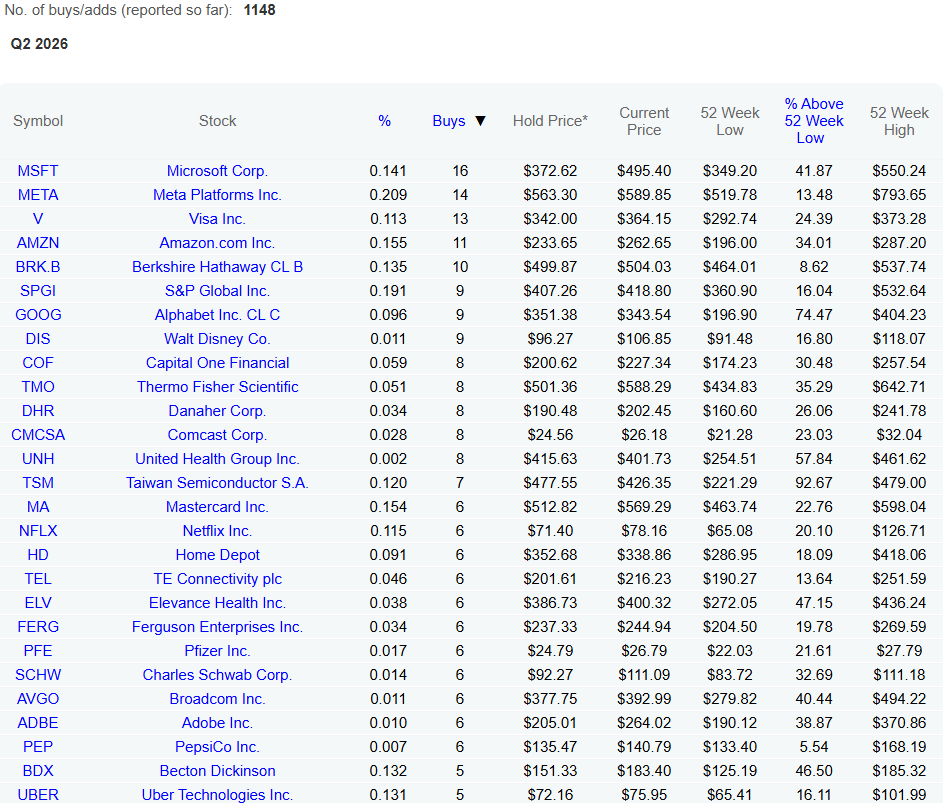
Largest Q2 Buys by Superinvestors
The price we pay matters.
A great business can still be a terrible investment at the wrong valuation.
And a stock purchased by a famous investor during the second quarter may look very different at today’s price.
So this week I wanted to take the analysis one step further.
First, we’re going to look at what the superinvestors actually bought.
Then I’ve compared the most interesting stocks against:
Wall Street’s current price targets;
expected growth;
historical valuation;
my own DCF models;
reverse-DCF expectations; and
the risk/reward I see at today’s prices.
And there are some major disagreements.
One company has more than 70% potential upside according to Wall Street, yet I still wouldn’t rank it first.
Another has remarkable agreement between superinvestors, analysts and my own valuation.
And one of the world’s largest companies has an even more interesting problem:
Wall Street sees roughly 24% upside. My DCF currently sees virtually none.
That difference is exactly why I think looking beyond the headline 13F purchase is so important.
If you’re new here, I publish weekly research on valuation, earnings power and what some of the world’s best investors are doing with their money.
First, An Important Warning About 13F Filings
Before looking at the purchases, there is one important distinction to make.
13F filings show us a snapshot of US-listed long positions held at the end of the quarter.
They don’t show every asset a manager owns.
They don’t reveal all cash positions, shorts or foreign holdings.
And crucially:
The reported price is not necessarily the price the investor actually paid.
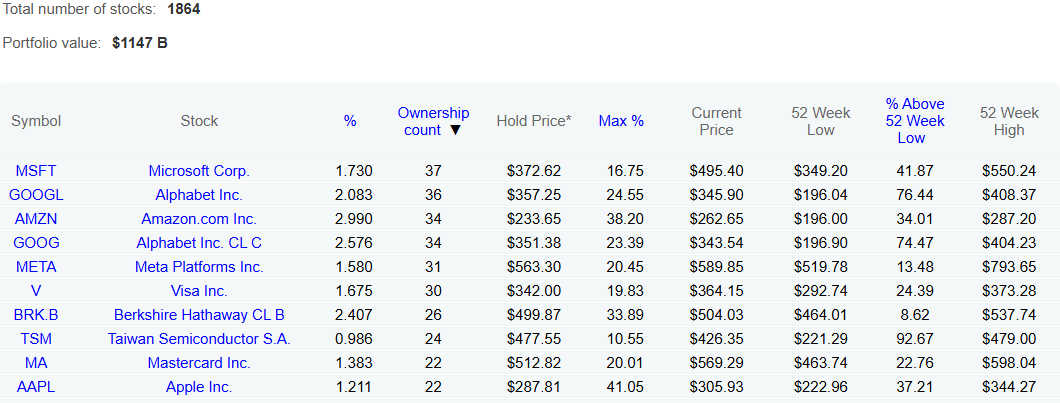
Most Held Stocks by Superinvestors
That means I don’t think the right question is:
“What did Bill Ackman buy so I can buy it too?”
The more useful questions are:
Where are respected investors independently reaching similar conclusions?
And:
Does the valuation still make sense today?
With that in mind, there were some fascinating moves this quarter.
Bill Ackman: A Major Portfolio Rotation
Ackman’s quarter was one of the most interesting.
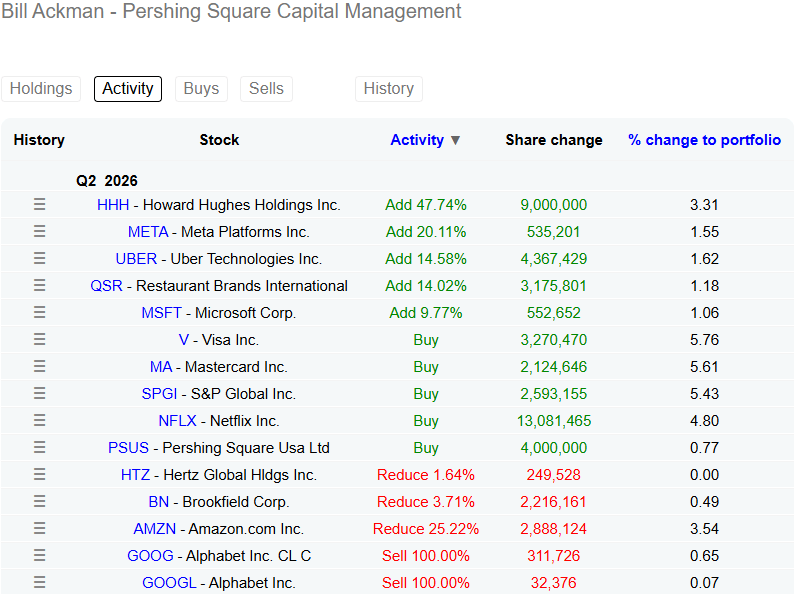
He opened new positions in:
Visa
Mastercard
S&P Global
Netflix
He also added to:
Uber
Meta
Restaurant Brands
Microsoft
Bill Ackman Q2 Activity
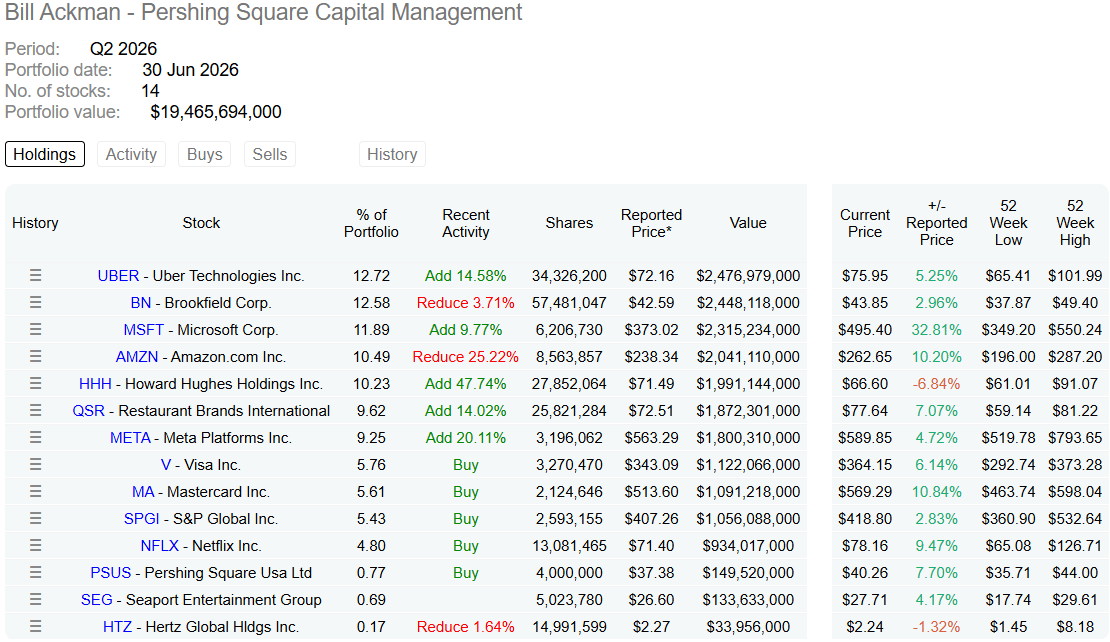
Uber became his largest disclosed position at around 12.7% of the portfolio.
At the same time, Ackman reduced Amazon by approximately 25% and exited both Alphabet share classes completely.
Bill Ackman’s Holdings
That is a significant portfolio shift.
There appears to be increasing exposure to businesses with powerful networks, recurring data, payments, platforms and high incremental margins.
And several of those same stocks appeared in other investors’ filings.
David Tepper: Buying Growth Aggressively
David Tepper took a more aggressive approach.
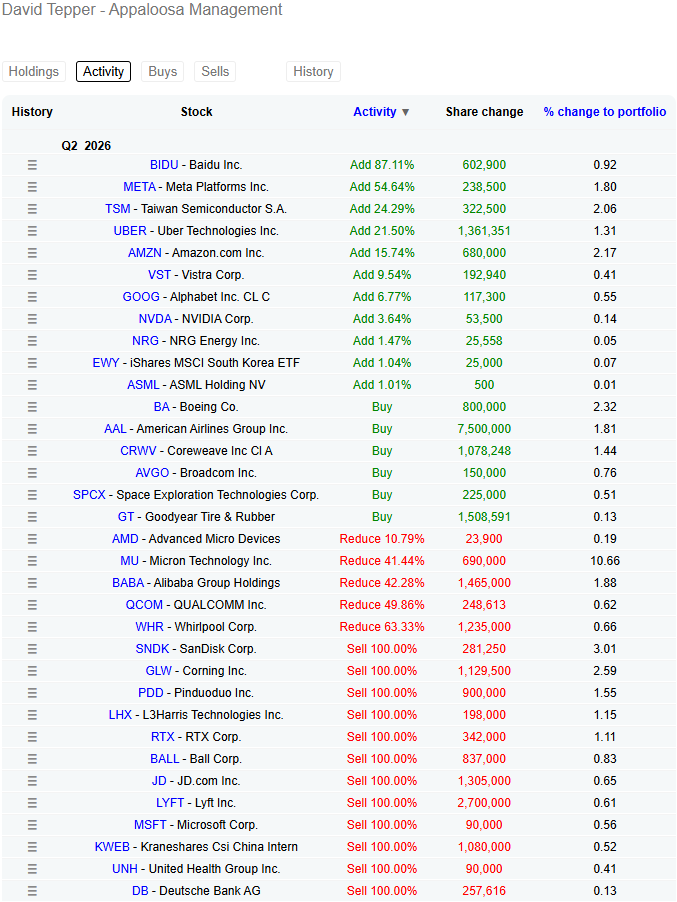
Among his additions:
Baidu +87%
Meta +55%
TSM +24%
Uber +22%
Amazon +16%
Tepper Q2 activity
He also purchased Boeing, American Airlines, CoreWeave, Broadcom and SpaceX.
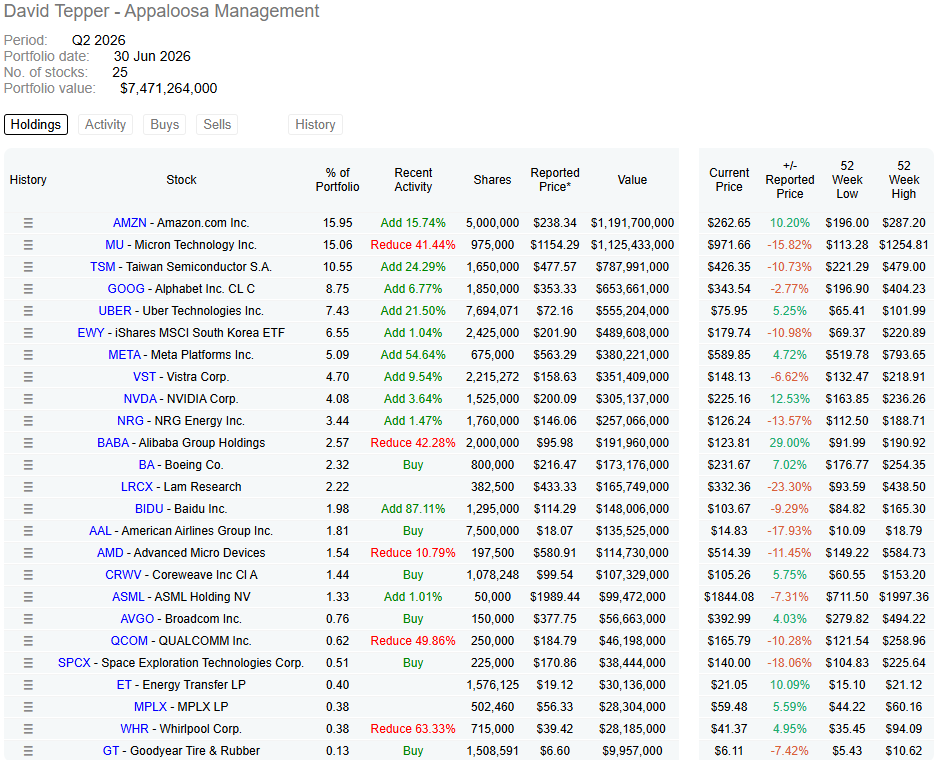
Amazon remained his largest disclosed holding.
Tepper’s Holdings
But importantly, this wasn’t simply indiscriminate enthusiasm for technology.
Tepper also reduced Micron, AMD, Alibaba and Qualcomm.
The interesting signal isn’t that Tepper is bullish on everything.
It’s where he chose to increase exposure.
And one of those names, Uber, is going to appear repeatedly.
Berkshire Hathaway: A Huge Alphabet Move
Perhaps the most eye-catching filing came from Berkshire Hathaway.
Berkshire dramatically increased its Alphabet exposure.
GOOG shares increased by more than 600%, while its GOOGL position also rose substantially.
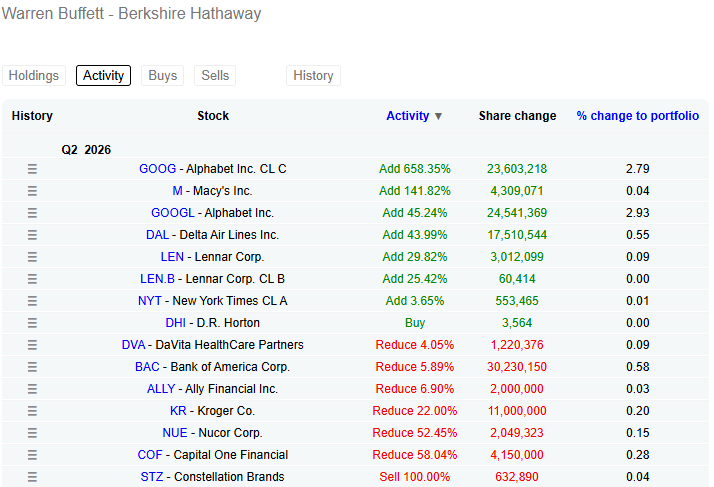
Berkshire Q2 Activity
Across the two share classes, Alphabet became one of Berkshire’s largest disclosed equity positions.
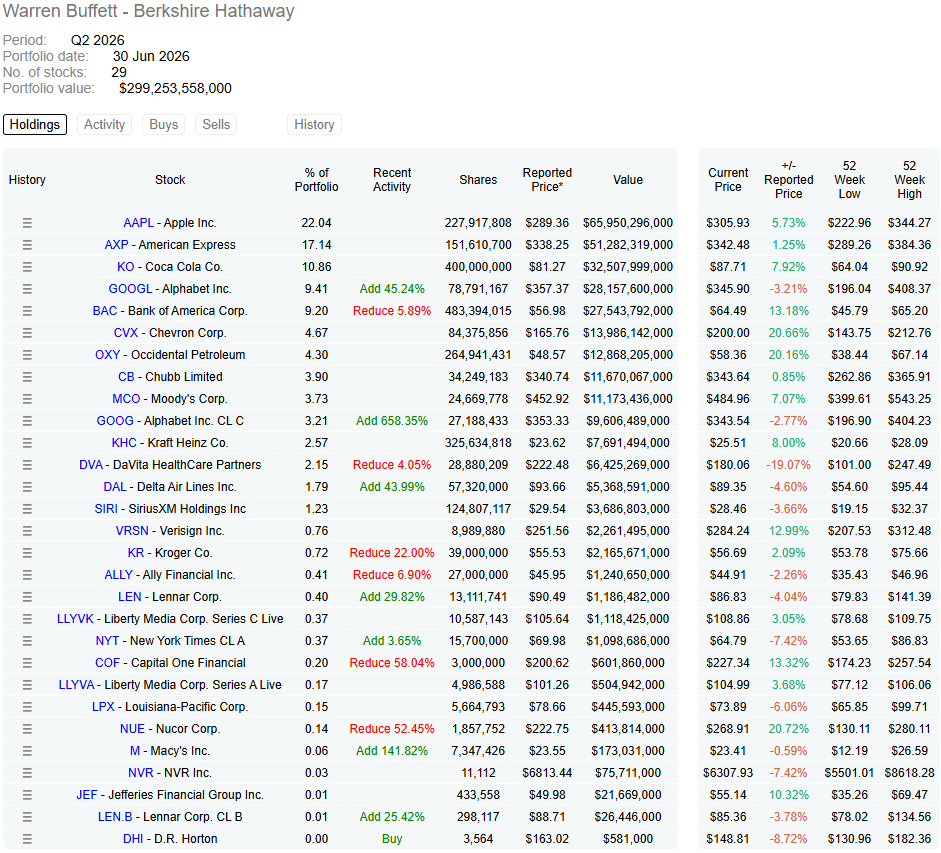
Berkshire Holdings
And this creates one of the most fascinating disagreements of the entire quarter.
Because while Berkshire was buying Alphabet aggressively…
Bill Ackman sold it completely.
Terry Smith reduced his position.
Meanwhile, Tepper, Chris Hohn and Seth Klarman were buying.
Great investors.
Completely different conclusions.
That’s exactly why I don’t believe following the famous name beside a filing is enough.
Pat Dorsey: Some Of The Quarter’s Most Interesting Purchases
Pat Dorsey’s portfolio produced several major additions:
Booking +80%
Uber +61%
S&P Global +42%
AppLovin +39%
Meta +24%
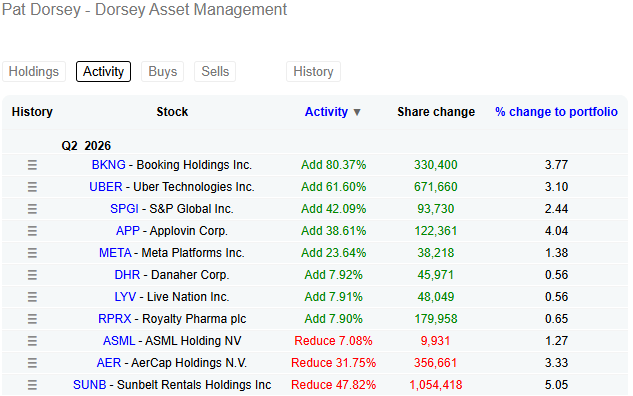
Pat Dorsey Q2 Activity
There isn’t one obvious industry connecting these companies.
Instead, the common theme is quality economics:
Networks.
Data.
Pricing power.
Asset-light business models.
Strong incremental margins.
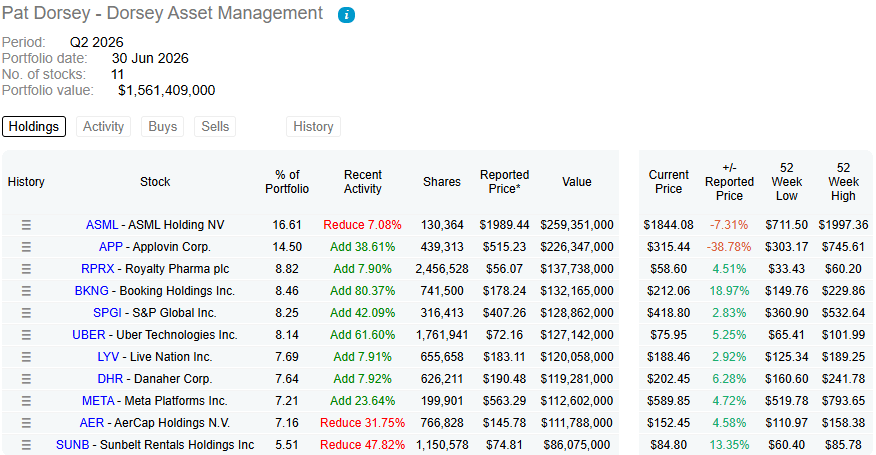
Dorsey’s Holdings
Uber, S&P Global and AppLovin are particularly interesting because other highly regarded managers were buying those companies too.
Terry Smith: A Very Different Portfolio
Terry Smith made an unusually large number of changes.
He opened 13 new positions, including:
Uber
Mastercard
TSM
Netflix
GE Vernova
AppLovin
TJX
NextTracker
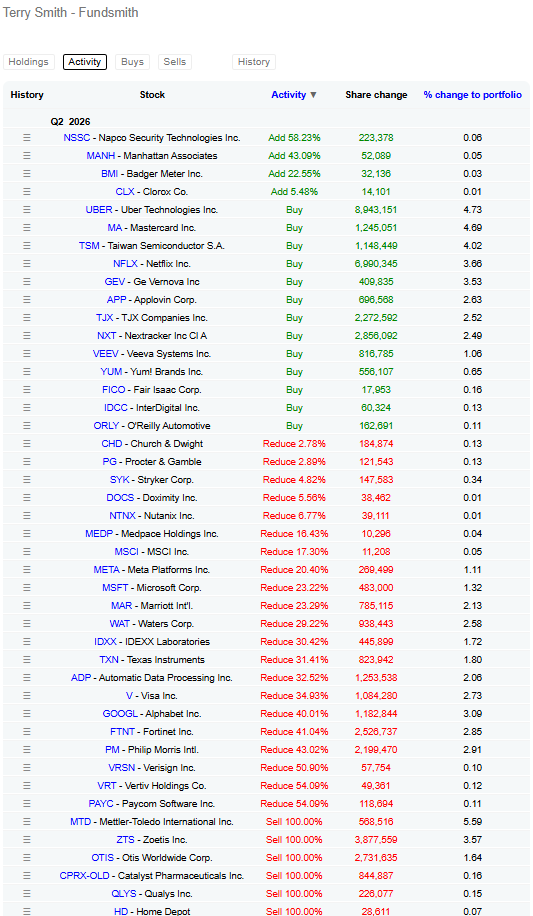
Terry Smith’s New Positions/Activity
Meanwhile, he reduced Alphabet, Visa, Microsoft and Meta, while exiting Home Depot completely.
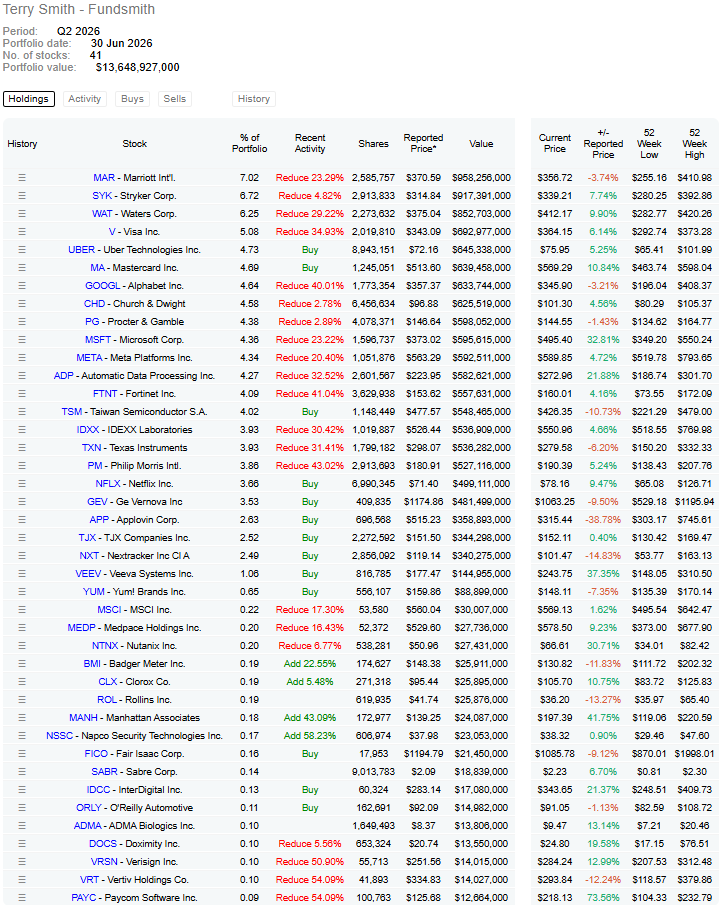
Terry Smith’s Holdings
Again, I wouldn’t interpret every reduction as bearish.
If a manager opens multiple new positions, that capital has to come from somewhere.
A trim can simply reflect position sizing, valuation or portfolio construction.
What interests me much more is when several unrelated investors independently buy the same company.
And that’s where things become particularly interesting.
Where The Superinvestors Agree
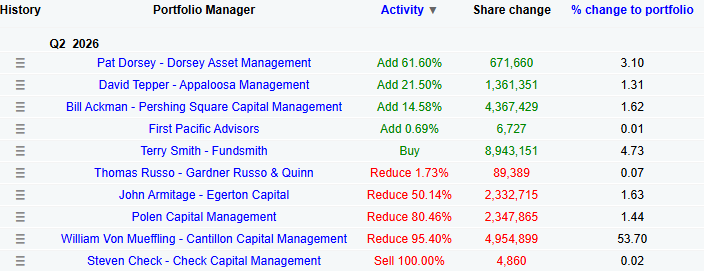
Uber Q2 Activity
Looking across the filings, several names keep appearing.
Uber
Ackman added.
Tepper added.
Pat Dorsey increased his position by more than 60%.
Terry Smith opened a new position.
Four very different investors independently decided to put additional capital into Uber.
That makes it one of the clearest consensus ideas in this group.
S&P Global
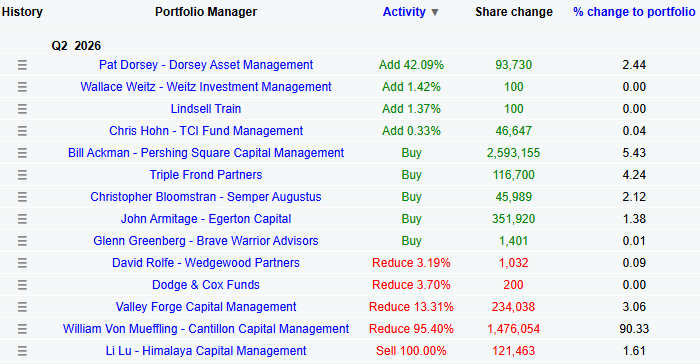
SPGI Q2 Activity
Ackman opened a new position.
Pat Dorsey increased his stake by more than 40%.
Chris Hohn added to an already significant position.
And across the wider group tracked in my research:
Nine managers bought or added S&P Global during the quarter.
It’s nowhere near as exciting a story as AI.
But sometimes that’s exactly what makes a setup interesting.
Mastercard
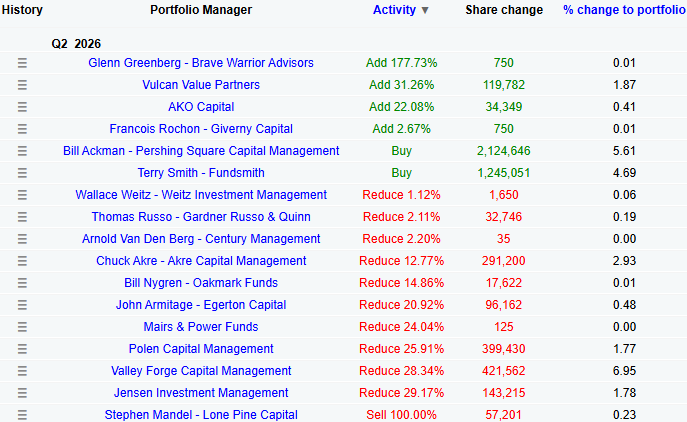
Mastercard Q2 Activity
Ackman bought Mastercard.
Terry Smith opened a position.
Chuck Akre reduced his holding, but Mastercard still represented roughly 20% of his disclosed portfolio.
Across the broader data, six tracked managers bought or added Mastercard and 22 already owned it.
Few businesses have the same combination of network effects, margins and consistency.
The question is simply how much of that quality is already priced in.
TSM
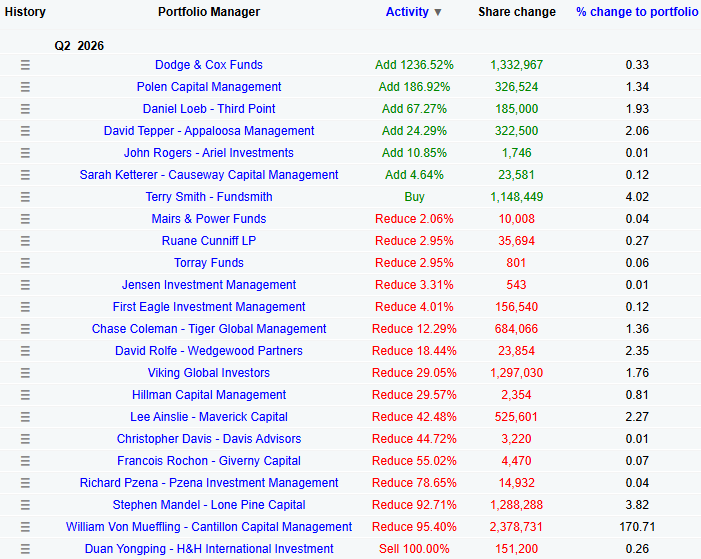
TSM Q2 Activity
Tepper added approximately 24%.
Terry Smith opened a new position.
And across the wider database, seven managers bought or added TSM while 24 tracked superinvestors already owned shares.
With AI infrastructure spending remaining enormous, the appeal is obvious.
But unlike some of the other stocks in this article, TSM’s valuation isn’t particularly depressed relative to its own history.
Meta
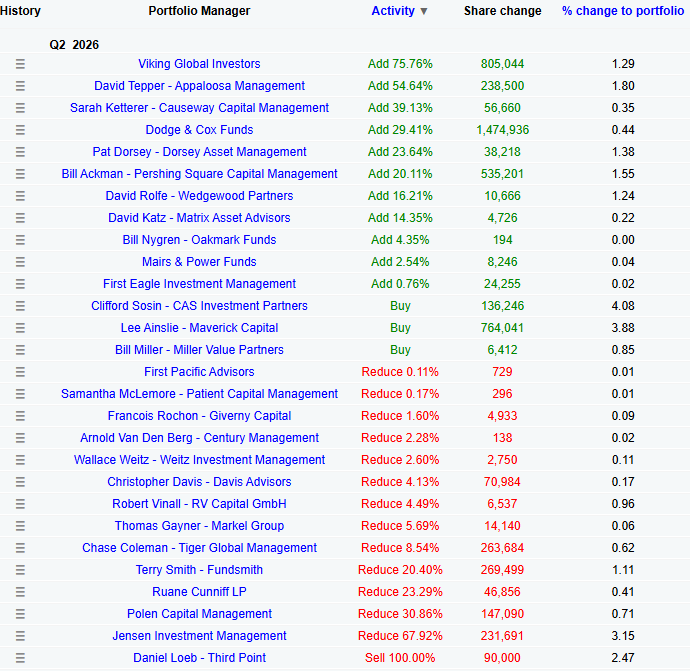
Meta Q2 Activity
Tepper increased Meta substantially.
Dorsey bought more.
Ackman added.
Terry Smith moved in the opposite direction and reduced his holding.
That disagreement is particularly interesting because Meta may be one of the clearest examples of the market trying to answer a difficult question:
How much should investors be willing to pay today for AI spending that may not produce its full financial return for years?
AppLovin
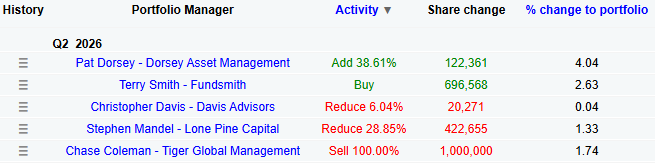
APP Q2 Activity
AppLovin might be the most controversial stock here.
Pat Dorsey increased his position.
Terry Smith opened a new one.
And they were buying after an enormous decline in the share price.
The operating forecasts remain extraordinary.
But so does the uncertainty.
We’ll come back to this one shortly.
The Lesson From The Filings
The takeaway from this quarter isn’t simply that famous investors are bullish.
They aren’t all buying the same thing.
They disagree.
They trim excellent businesses.
They sell stocks other great investors are buying.
They rotate capital.
And they operate with different time horizons, portfolio constraints and required returns.
That’s why I think 13F filings work best as an idea generator.
Not as a shopping list.
The part that matters to us now is whether these ideas still make sense at today’s prices.
And that’s where the analysis becomes much more interesting.
If you know another investor who follows 13F filings, send them this breakdown.
So Which Of These Stocks Is Actually Attractive Today?
Knowing what a superinvestor bought is only half of the analysis.
A filing can tell us where capital moved.
It doesn’t tell us whether a stock still offers an attractive return from today’s price.
So I took the eight most interesting companies from the research and compared three different signals:
1. What the superinvestors are doing
2. What Wall Street believes the stocks are worth
3. What my own valuation work suggests
And the differences are substantial.
One company offers the highest Wall Street upside in the entire group.
Another has remarkably strong agreement between superinvestors, analysts and my valuation.
And one of the world’s largest companies has a major problem:
Wall Street sees around 24% upside. My DCF currently sees virtually none.
For Premium members, below I’m breaking down all eight before revealing the risk/reward ranking I would use today.