


Markets reward discipline.
But most investors spend their time in the wrong place.
They focus on:
valuation multiples
growth rates
analyst price targets
All useful.
None sufficient.
Because none of them answer the one question that ultimately matters:
Can this business withstand pressure?
That answer doesn’t sit in the income statement.
It sits on the balance sheet.
And most investors only realise that when it’s too late.
By then, the damage is already done.
Why This Only Shows Up When It’s Too Late
In strong markets, balance sheets are largely ignored.
credit is cheap
liquidity is abundant
refinancing is easy
Weakness doesn’t disappear.
It just gets delayed.
But when conditions tighten, the difference between companies becomes obvious very quickly.
Not gradually.
All at once.
Two businesses can look identical on the surface:
similar growth
similar margins
similar valuation
But produce completely different outcomes.
The difference is rarely the business model.
It’s this:
One has flexibility. The other has constraints.
The 10-Second Balance Sheet Test
If I only had a few seconds to assess a company’s financial strength, I would start with one metric:
Net Debt relative to earnings power
In simple terms:
After accounting for cash, how many years of earnings would it take to repay the debt?
This is typically measured as:
Net Debt / EBITDA
How to Use It
Start with:
Total Debt – Cash = Net Debt
Then compare it to earnings.
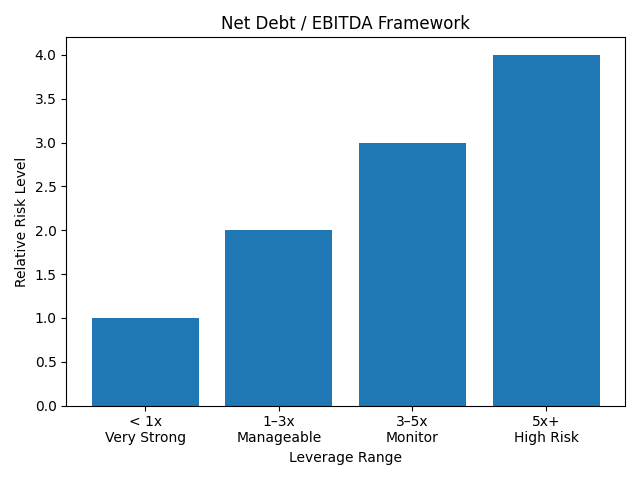
As a rough framework:
< 1x → structurally strong
1–3x → manageable
3–5x → increasingly dependent on stable execution
5x+ → vulnerable to disruption
What This Looks Like in Practice
At the lower end of the spectrum (<1x Net Debt / EBITDA), you’ll typically find businesses with:
strong free cash flow generation
high margins
and minimal reliance on external financing
Examples often include:
large-cap technology companies with net cash positions
asset-light software platforms
and certain high-quality compounders
These businesses don’t just survive downturns.
They operate from a position of strength.
They don’t need capital markets.
That’s the key difference.
But This Is Only the Starting Point
One of the biggest mistakes investors make is reducing balance sheet analysis to a single ratio.
Net Debt / EBITDA is useful.
But it doesn’t tell the full story.
A proper assessment looks at three things:
1. Liquidity (Short-Term Survival)
Before anything else, ask:
Can this business meet its obligations over the next 12–24 months?
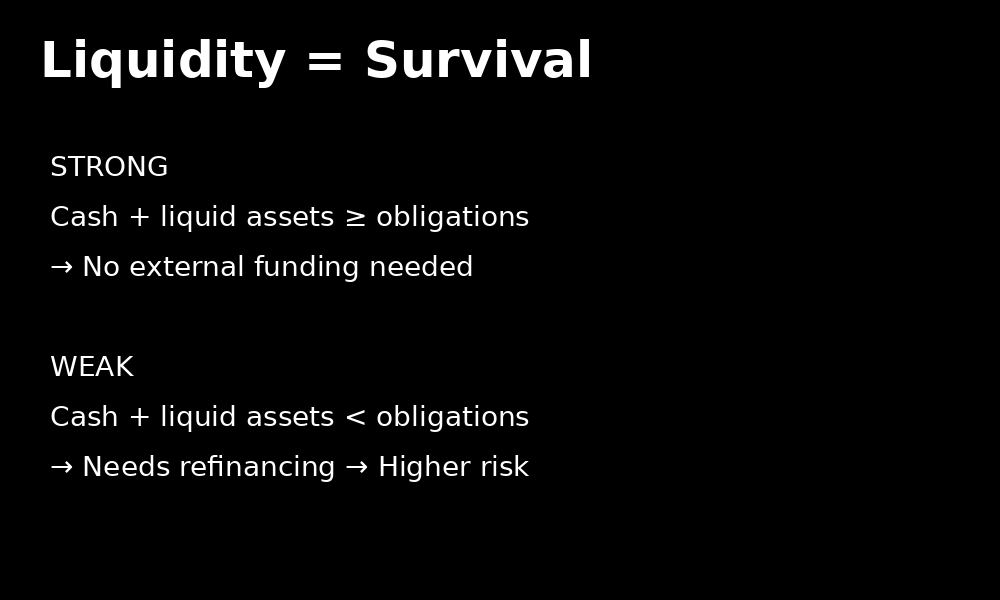
Simple framework: liquidity determines whether a company can survive short-term stress.
This is where most problems start.
Look at:
cash
short-term assets
vs short-term liabilities
A company can be “cheap” and still run into trouble if liquidity is weak.
Because:
refinancing may be required
capital may need to be raised
or assets may need to be sold
Simple signal:
Strong liquidity → flexibility
Weak liquidity → dependence
And dependence is risk.
2. Debt Structure (When does the risk actually show up?)
Not all debt is equal.
What matters is:
When it needs to be repaid.
Two companies with identical leverage can have very different risk profiles.
One might have:
long-dated debt
fixed rates
minimal near-term refinancing
The other might have:
near-term maturities
floating-rate exposure
refinancing risk
💡 Key insight:
Most investors don’t get into trouble because a company has debt.
They get into trouble because that debt becomes relevant at the wrong time.
3. Cash Flow vs Earnings (Can the company actually handle it?)
EBITDA is useful.
But it isn’t cash.
What matters is:
How much real cash the business generates after everything else.
Look at:
free cash flow
capital intensity
consistency of cash generation
Because:
A company can look profitable on paper…
…but still struggle to manage its obligations in reality.
Bringing It Together
A strong balance sheet isn’t defined by one number.
It’s defined by alignment.
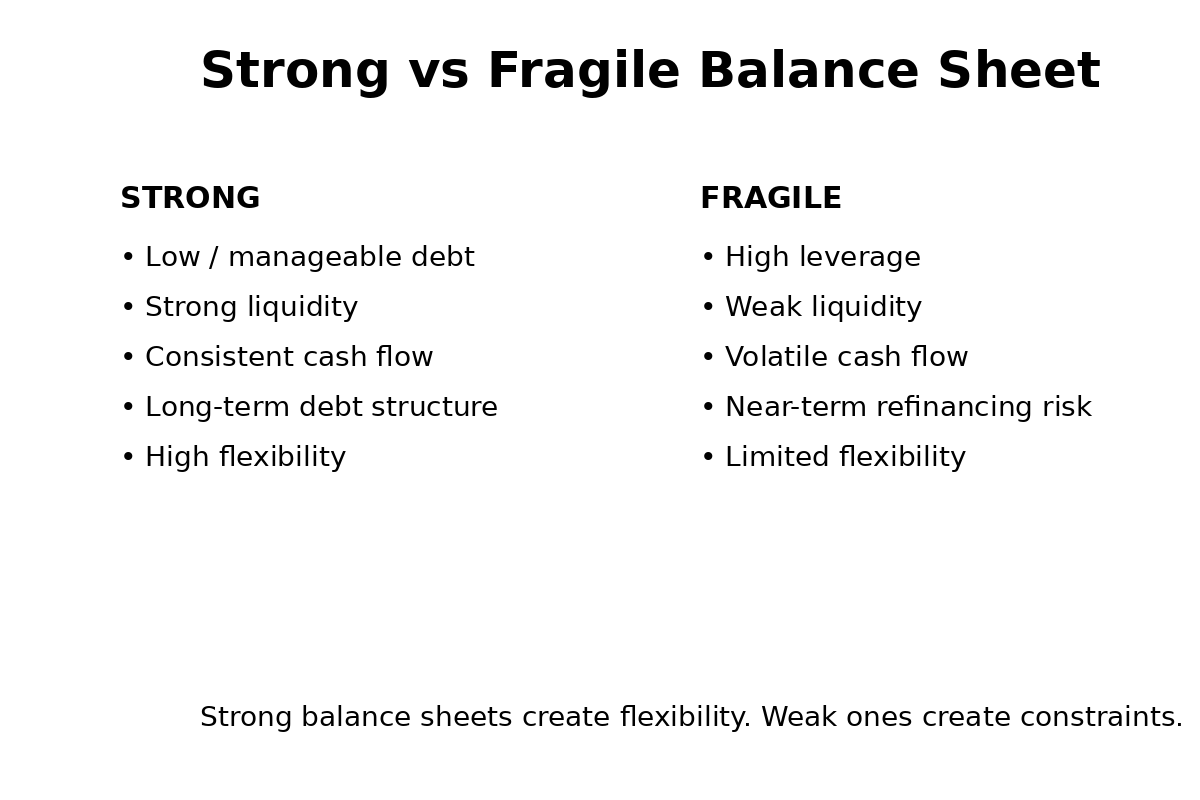
A strong balance sheet creates flexibility.
A weak one creates constraints.
It’s defined by alignment:
manageable leverage
strong liquidity
predictable cash flow
sensible debt structure
When all four are present:
The business has flexibility
When they aren’t:
The business becomes fragile
The Real Risk Isn’t Debt — It’s Fragility
Debt doesn’t kill businesses.
Fragility does.
Leverage simply exposes it.
When flexibility disappears:
small problems become big problems
refinancing becomes expensive
optionality disappears
That’s when you see:
dilution
dividend cuts
forced decisions
permanent repricing
A Better Way to Think About Risk
Most investors ask:
“Is this stock cheap?”
A better question — and the one that actually matters — is:
“What happens if things go slightly wrong?”
Because if the balance sheet is strong:
time is on your side
the company can adapt
valuation tends to recover
If it isn’t:
time works against you
and downside compounds
Why This Matters Right Now
Over the past few weeks, markets have repriced risk quickly.
Across multiple sectors, large-cap companies have seen meaningful pullbacks.
That creates opportunity.
But also risk.
Because:
Not all drawdowns are mispricings.
Some are opportunities.
Others are early warnings.
The balance sheet is often what separates the two.
How I Apply This in Practice
This is exactly why, in my monthly screens, I don’t just look for upside.
Every company in my screen passes this balance sheet framework before valuation is even considered.
I filter for companies where:
valuation is attractive
earnings are durable
and the balance sheet provides flexibility
Because:
Upside without durability isn’t opportunity. It’s leverage disguised as value.
What This Looks Like in the Current Market
In my latest report:
119 companies were screened
30 qualified based on strict criteria
A smaller group met my execution threshold
From those, five stand out most clearly.
Not just because of upside.
But because:
downside is defined
balance sheets are resilient
and risk/reward is asymmetric
Unlock the Full Breakdown
🔒 Paid members get access to:
The Top 5 ranked stocks this month
Exact buy ranges
Downside modelling
The full 30-stock screening dataset
Allocation framework
If you’re allocating real capital:
Entry price and downside matter just as much as upside.
Final Thought
Most investors focus on what can go right.
The balance sheet tells you what can go wrong.
And over time:
Avoiding permanent losses matters more than capturing every opportunity.
Markets reward discipline.
Not optimism. Not narratives. Not hope.
👉 If you found this valuable, consider sharing or upgrading to access the full monthly reports.
The distinction between debt as a number and debt structure as a risk factor is the part that often gets missed. Two companies with the same leverage can have very different outcomes depending on when it matures and how it's priced.